Published: 9 January 2026 · Last updated: 16 May 2026 · Author: Matthew Walker
AI voice pilot to production: an enterprise playbook
How to move from proof-of-concept to production-grade AI voice operations with clear gates, outcome metrics, and cross-functional ownership.
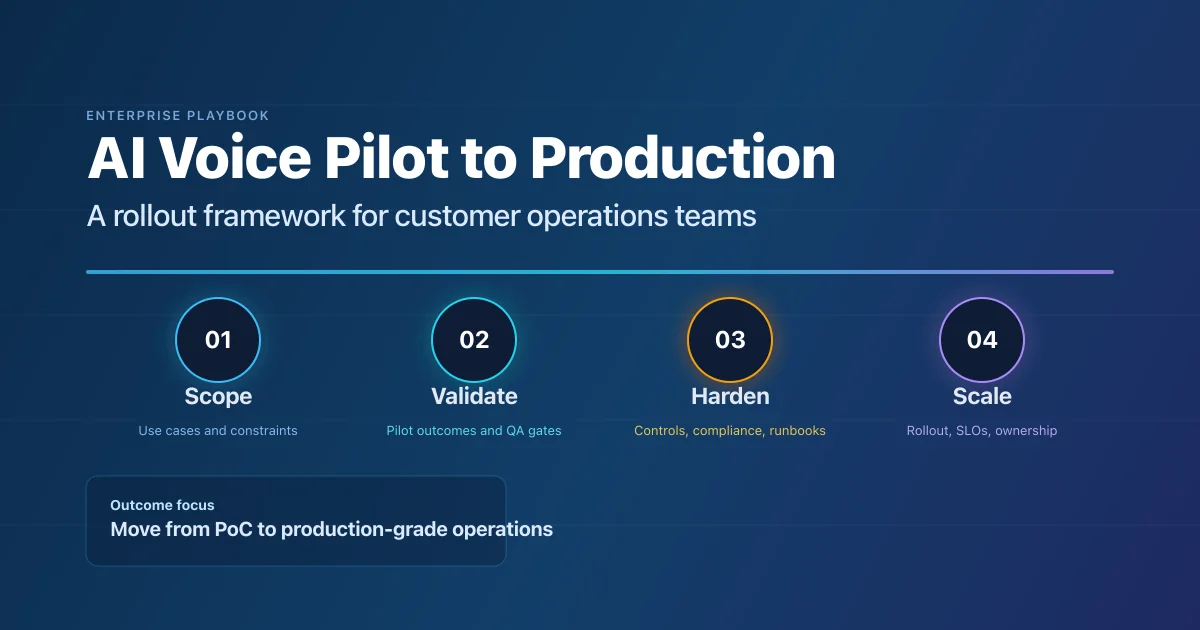
Most AI voice initiatives fail in the gap between “pilot looked good” and “production must be reliable.”
This playbook gives you a practical sequence to move from pilot to production with discipline.
The audience is operations, product, technology, and transformation teams evaluating AI voice for real workflows: inbound triage, appointment booking, customer support, after-hours overflow, qualification, and follow-up. The playbook assumes you want production value, not a demo that works only with friendly test calls.
TL;DR
- Pick one high-value workflow first.
- Define measurable success and failure criteria before launch.
- Harden integrations, escalation, and QA before expanding scope.
- Scale by repeating a proven template, not custom one-offs.
- Treat the first production month as a learning period with tight monitoring.
Phase 1: Scope (weeks 1 to 2)
Start narrow and measurable.
Choose one workflow
Good candidates:
- high inbound volume
- repetitive intent patterns
- meaningful business impact
- clear handoff path if uncertain
Poor candidates for a first workflow:
- open-ended complaint handling
- regulated advice
- emergency triage
- highly emotional conversations
- workflows with unclear ownership
- flows that require many untested integrations at once
Start with a workflow where success and failure are easy to see.
Define baseline metrics
Capture current state:
- average response time
- missed/abandoned interaction rate
- conversion to next step
- average handling effort for staff
Without baseline data, you cannot prove impact.
Useful baseline examples:
| Workflow | Baseline to capture |
|---|---|
| Appointment booking | missed calls, booking conversion, reschedules, staff time |
| After-hours overflow | call volume, voicemail rate, callback delay, lead quality |
| Quote capture | enquiry volume, complete quote details, response time |
| Support triage | reason codes, repeat contacts, escalation rate |
| Existing booking management | lookup success, cancel/reschedule volume, staff interruption |
Phase 1 output
At the end of scoping, you should have:
- one selected workflow
- excluded workflows
- success metrics
- stop conditions
- escalation owner
- data and privacy decisions
- first test scenarios
- go/no-go owner
Phase 2: Validate (weeks 3 to 5)
Run a controlled pilot with strict boundaries.
Pilot checklist
- limited traffic slice
- explicit fallback to human
- daily QA sample review
- known issue log with owners
- stop conditions documented
Pilot success criteria example
- containment above target
- escalation accuracy above target
- no unresolved severe incidents
- positive directional movement on conversion or handling time
What to test before real callers
Run scenario calls that include:
- happy path
- wrong number
- caller interruption
- caller asks for a human
- caller changes their mind
- missing required field
- tool timeout
- unavailable booking slot
- sensitive-topic request
- angry or confused caller
- after-hours request
If the workflow cannot handle these in test conditions, it is not ready for a live pilot.
Pilot traffic design
Avoid sending all traffic to the pilot on day one. Safer options include:
- after-hours only
- one phone line
- one business unit
- one location
- overflow only
- a small percentage of traffic
The goal is evidence. A narrow pilot that produces clean learning is better than a broad pilot that creates confusion.
Phase 3: Harden (weeks 6 to 9)
Turn a successful pilot into production-safe operations.
Technical hardening
- integration retries and timeout strategy
- circuit breaking for downstream failures
- idempotency on external actions
- monitoring and alerting on key failure modes
Operational hardening
- incident runbook
- ownership by shift/team
- weekly quality and risk review
- structured release notes for prompt/flow changes
This is where many teams skip steps and create expensive production drift.
Handoff hardening
For most businesses, the call is only useful if the next human action is easier. Harden the handoff:
- decide who receives each call category
- include structured fields, not just a paragraph summary
- separate urgent and routine messages
- include tool outcomes and failure states
- make it obvious whether staff need to act
- avoid exposing unnecessary sensitive data
Latency hardening
Voice AI feels broken when callers hear silence. During hardening, review:
- time to first useful response
- tool lookup delay
- workflow hops before a spoken bridge
- whether the caller hears a natural acknowledgement before slow actions
- whether fallback language is clear when tools fail
See How to reduce AI receptionist latency and make voice agents work in production for the more detailed latency playbook.
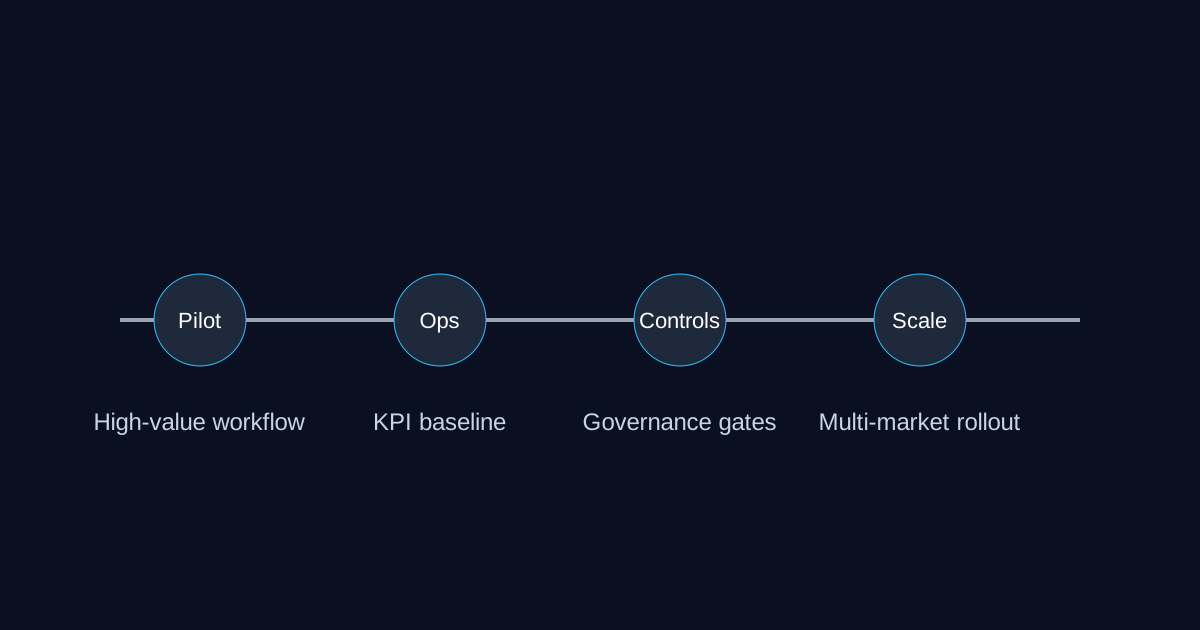
Phase 4: Scale (weeks 10+)
Scale only after controls are proven.
Expansion rules
- add one adjacent workflow at a time
- reuse the same control framework
- require launch-gate signoff per workflow
- keep shared metrics definitions enterprise-wide
Organizational scaling
- train frontline teams on escalation behaviour
- align CX, operations, engineering, and risk on one KPI scorecard
- avoid fragmented ownership by business unit
Phase 5: Operate continuously
Production is not the end state. It is the beginning of operations.
Create a recurring rhythm:
- weekly call review for the first month
- monthly performance review once stable
- quarterly policy and privacy review
- release notes for meaningful changes
- regression calls after prompt, tool, or workflow updates
- periodic review of transcripts and retention rules
The agent should become more aligned with the business over time. If nobody reviews evidence, it drifts.
Scorecard template
Use one scorecard per workflow:
- Customer: completion rate, CSAT, complaint rate
- Operations: containment, escalation quality, queue reduction
- Risk: policy violations, incident count, mean time to recovery
- Financial: recovered revenue, cost per resolved interaction
Add leading indicators as well:
- time to first useful response
- tool failure rate
- incomplete handoff rate
- repeat caller clarification
- escalation false positives
- escalation false negatives
- staff usefulness score
Lagging metrics like cost reduction are useful, but they arrive too late to manage quality week by week.
Red flags before scaling
- unresolved recurring incidents
- weak escalation precision
- poor observability across integrations
- no clear owner for after-hours incident response
If these exist, hold expansion and fix the foundation.
What leadership should ask
Executives do not need to inspect every prompt. They should ask:
- What workflow is live?
- What is explicitly out of scope?
- What happens when the AI is unsure?
- What did the last 20 reviewed calls teach us?
- Which incidents occurred and how were they resolved?
- What changed since last week?
- What must be true before we expand?
If the team cannot answer those questions, the program is not ready to scale.
Suggested rollout order
- inbound FAQ and triage
- scheduling and qualification
- after-hours overflow
- outbound follow-up workflows
This order is only a starting point. A dental group, accounting firm, property manager, and cleaning company will all have different risk profiles. The principle is stable: prove one workflow, then add the next adjacent workflow.
CTA
If you are moving from pilot to production and want structured support, we can help you define success criteria, harden integrations, and build the operating model so your voice AI program scales safely.
Valory is a service, not software: we design, build, and manage voice AI operations so your team gets outcomes without the infrastructure burden.
Book a walkthrough or browse more guides in our articles library.
FAQ
What counts as a successful pilot?
A pilot is successful when containment, escalation accuracy, and conversion metrics meet pre-defined thresholds — and there are no unresolved severe incidents. Success means the agent is production-safe, not just demo-ready.
How do I know when to move from pilot to production?
When your stop conditions have not been triggered, your KPI baselines show positive movement, and your operational hardening checklist is complete. If any of those are missing, hold and fix first.
Can I skip the hardening phase if the pilot went well?
No. Pilot conditions are controlled. Production conditions are not. Hardening covers failure modes, incident response, and integration reliability that pilots rarely test. Skipping this creates the most common enterprise failure pattern.
How many workflows should I scale to at once?
One at a time. Add the next workflow only after the current one passes its launch gate. Parallel rollouts fragment quality and make it harder to learn from outcomes.
What is the most common reason enterprise voice AI programs stall?
Expanding before the first workflow is hardened. Teams get excited about breadth and skip the depth work — incident runbooks, escalation precision, integration retries — that makes production sustainable.
Should a pilot use real callers?
Eventually, yes. Synthetic calls are useful, but real callers reveal interruptions, accents, phrasing, frustration, and edge cases. Start controlled, monitor closely, and keep rollback simple.
How long should hardening take?
It depends on risk and integration complexity. A simple message-capture workflow may harden quickly. A booking workflow with calendars, CRM, SMS, staff routing, and compliance boundaries needs more testing and post-launch review.
What should not be in the first pilot?
Avoid high-risk judgement, regulated advice, emergency handling, broad complaints, and workflows with unclear ownership. Those can come later if there is a strong reason and a stronger control framework.
Related reading
- ElevenLabs + BCG: what it signals for enterprise voice AI — what the ElevenLabs and BCG strategic partnership means for enterprise voice AI governance and operating models.
- Enterprise AI voice governance checklist — a launch-ready checklist covering every control domain before you go live.
- AI receptionist vendor checklist — vendor questions for buyers evaluating production readiness.