Published: 27 January 2026 · Last updated: 16 May 2026
Enterprise AI voice governance checklist
A launch-ready checklist covering security, compliance, runtime controls, escalation design, and quality operations for enterprise AI voice deployments.
 By Matthew WalkerFounder, Valory AI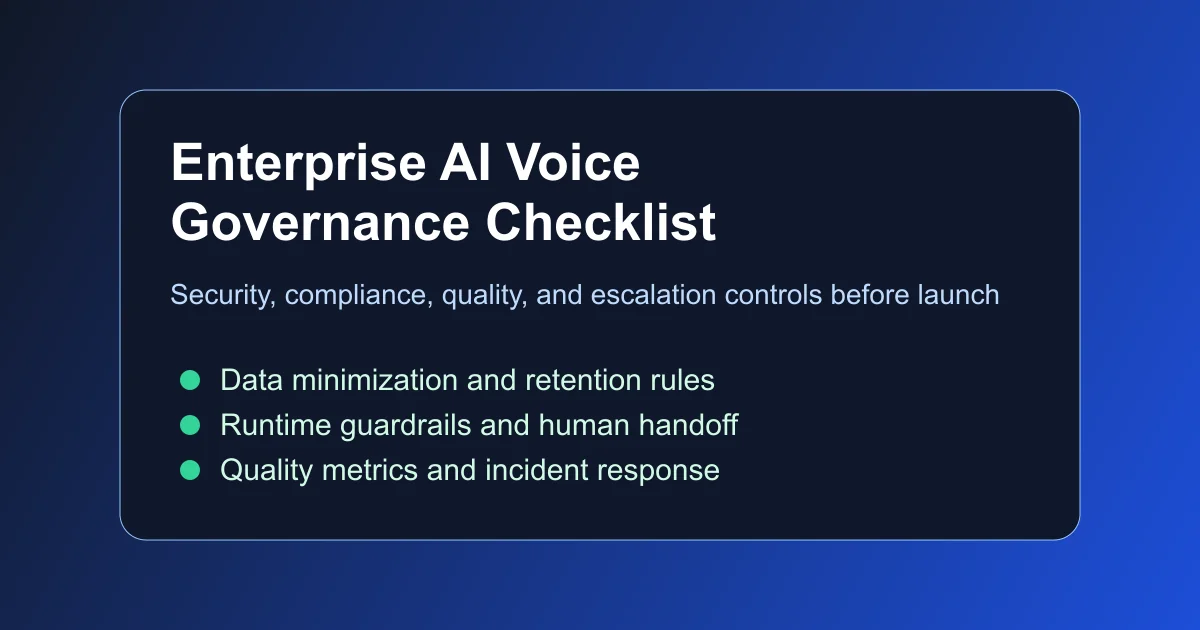
Governance is what separates a voice AI pilot from a sustainable production capability.
This checklist is built for enterprise teams that need confidence across legal, security, operations, and customer experience before scaling.
The goal is not to slow delivery down. Good governance makes the rollout faster because every team knows what must be true before traffic moves: who owns the agent, what the agent may do, how incidents are handled, what data is retained, and how quality is measured.
TL;DR
- Governance should be built into launch, not added after incidents.
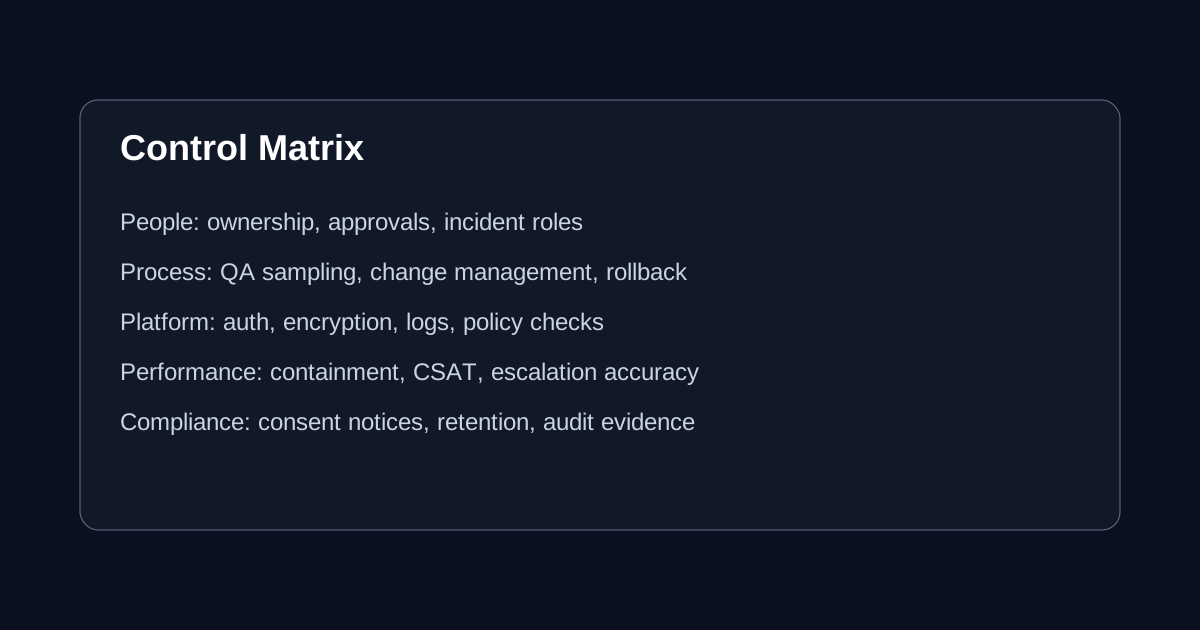
- You need controls across people, process, platform, and performance.
- High-trust deployments have clear escalation logic and auditable decision trails.
- Use a release gate: if a control is missing, rollout stops.
- Start with the controls that match the risk of the workflow. A booking assistant and a regulated advice workflow do not need the same risk posture, but both need ownership and QA.
Who this checklist is for
Use this checklist if your voice AI program has any of the following:
- customer-facing production traffic
- regulated or sensitive interactions
- integrations that can create, update, or cancel records
- call recording, transcript storage, or personal information capture
- multiple business units or teams relying on the same agent
- escalation paths to humans
- executive expectations around cost reduction or service quality
For smaller Australian service businesses, the same principles apply at a lighter scale. See AI phone agents in Australia: privacy and call recording for a practical privacy-focused guide.
Pre-launch control domains
1) Business and ownership
- Named executive sponsor
- Named operational owner
- Named technical owner
- Written success criteria and rollback criteria
- Defined change-approval process
Ownership is the first control because voice AI crosses functions. Operations cares about call outcomes. Engineering cares about integrations. Risk and legal care about data, consent, and claims. Customer teams care about complaints and handoff quality.
Document:
- who approves launch
- who approves prompt and workflow changes
- who can pause traffic
- who reviews incidents
- who owns vendor relationships
- who reports performance to leadership
If nobody owns the whole system, the agent becomes a collection of local decisions rather than a governed customer channel.
2) Security and platform controls
- Secrets management and key rotation policy
- Least-privilege access for integrations
- Encryption in transit and at rest for sensitive data
- Request authentication for all tool calls and webhooks
- Log retention and access-control policy documented
Voice AI security is not only about the model. The highest practical risks usually sit around connected tools and stored conversation data.
Review:
| Area | Governance question |
|---|---|
| Webhooks | Are inbound requests authenticated and replay-resistant? |
| Tool calls | Can the agent only call approved endpoints with approved fields? |
| Credentials | Are API keys stored securely and rotated when staff or vendors change? |
| Data access | Who can view recordings, transcripts, summaries, and call metadata? |
| Environments | Are test credentials separated from production systems? |
| Audit logs | Can you see who changed prompts, workflow rules, or integrations? |
For any tool that can create a booking, update a CRM, send an SMS, or notify staff, assume it needs the same discipline as any other production integration.
3) Privacy and compliance
- Jurisdictional obligations mapped (including Australia-specific obligations where relevant)
- Consent and disclosure language approved
- Data minimization rules documented
- Retention and deletion lifecycle defined
- Audit evidence capture process agreed
Privacy controls should be decided before the first live call. At minimum, document:
- whether calls are recorded
- how callers are told
- what transcripts are stored
- which fields the agent should not collect
- retention period
- deletion process
- staff access rules
- vendor subprocessors and hosting location
For Australian deployments, teams should consider Australian Privacy Act obligations, state-based listening and surveillance expectations, and industry-specific requirements. This is not a substitute for legal advice; it is an operational checklist for what to document.
4) Runtime behaviour controls
- Explicit “do not do” policy list (no guessing, no sensitive advice, etc.)
- Escalation triggers defined and tested
- Fallback path for external service failures
- Timeout and retry strategy with circuit breaking
- Human takeover path measurable and staffed
Runtime controls define how the agent behaves when things get messy.
Examples:
- If the caller asks for legal, tax, clinical, financial, or emergency advice, escalate or use approved non-advice wording.
- If a booking system times out, do not claim the booking is confirmed.
- If a caller repeats a request for a human, do not keep trying to solve the call automatically.
- If the agent is uncertain which staff member the caller requested, confirm or route to a team fallback.
- If caller frustration rises, capture a callback or transfer according to policy.
These rules should be tested as scenarios, not just written in a policy document.
5) Quality and operational readiness
- Baseline metrics recorded before launch
- QA sampling cadence and rubric defined
- Incident severity matrix and response SLA defined
- On-call owner and escalation tree documented
- Weekly optimization ritual booked
Quality operations are where pilots become reliable. A launch is not finished when the agent answers the first call. The first month should include structured review of real calls, failures, edge cases, and staff feedback.
Useful QA dimensions:
- caller understood disclosure
- intent classified correctly
- tone was professional
- no prohibited advice
- required fields captured
- tool calls happened in the right order
- escalation triggered when needed
- handoff was useful to staff
- failure language was safe and clear
Launch gate: minimum viable governance
Before production traffic, require:
-
Policy-safe behaviour under failure conditions Timeouts, integration failures, and unexpected prompts should route safely.
-
Escalation precision above target threshold Not just “handoff exists,” but “handoff occurs when it should.”
-
Audit trail completeness For any high-risk interaction, you can reconstruct what happened.
-
Rollback readiness You can disable or constrain scope in minutes, not days.
Add a fifth gate for connected workflows:
- Action safety Any workflow that creates, changes, cancels, sends, or escalates something has idempotency, logging, and human-readable evidence. If the agent creates a booking or sends a notification, staff should be able to see what happened and why.
Governance artefacts to create
Do not rely on tribal knowledge. Create a small set of artefacts:
| Artefact | Purpose |
|---|---|
| Workflow map | Shows intents, branches, tools, escalation, and closeout paths |
| Approved answer bank | Keeps FAQs and sensitive topics consistent |
| Do-not-answer list | Prevents advice drift and unsafe improvisation |
| Tool inventory | Lists every external system the agent can touch |
| Data map | Describes recordings, transcripts, summaries, metadata, and retention |
| Incident runbook | Explains severity, owner, communication, rollback, and review |
| QA rubric | Makes call review consistent across reviewers |
| Change log | Records prompt, workflow, tool, and policy changes |
For teams moving past a demo, these documents matter more than a beautiful prototype.
Post-launch governance cadence
Daily (first two weeks)
- review incidents
- review low-confidence interactions
- patch top failure patterns quickly
Weekly
- KPI trend review with operations + product + risk
- policy exception review
- backlog prioritization for fixes
Monthly
- control attestation refresh
- model/flow change-risk review
- expansion readiness decision
Example incident severity matrix
| Severity | Example | Response |
|---|---|---|
| Sev 1 | Agent gives prohibited advice, confirms action incorrectly, exposes sensitive data | Pause affected workflow, notify owner, preserve evidence, root-cause review |
| Sev 2 | Repeated wrong routing, booking failures, escalation missed | Patch workflow, increase QA sampling, notify affected team |
| Sev 3 | Awkward phrasing, minor handoff omission, non-critical confusion | Backlog and fix in normal tuning cycle |
| Sev 4 | Cosmetic issue or copy preference | Batch with regular optimisation |
The point is not to over-process every issue. The point is to know when the response must be immediate.
Anti-patterns to avoid
- Shipping without named owners
- Treating QA as optional after launch
- Relying on anecdotal success instead of measured outcomes
- Expanding scope before hardening escalation logic
- Letting each business unit invent its own prompt and controls
- Connecting tools before the escalation and failure paths are tested
- Treating transcripts as harmless because they are "just text"
- Measuring containment without measuring call quality
What to measure
Good governance needs metrics that represent customer experience, risk, and operations.
Track:
- call completion and abandonment
- escalation rate and escalation accuracy
- tool success and failure rate
- average time before first useful response
- prohibited-topic attempts and safe refusals
- complaint mentions
- staff usefulness rating for handoffs
- incident count by severity
- change volume and rollback events
Do not optimise only for containment. A high containment rate can hide poor caller experience if the agent traps people, avoids escalation, or gives shallow answers.
CTA
If you want help building a governance framework for your voice AI program, we can design the control model, launch gates, and review cadences so your team ships with confidence and scales without rework.
Valory is a service, not software: we design, build, and manage voice AI operations so your team gets outcomes without the infrastructure burden.
Book a walkthrough or browse more guides in our articles library.
FAQ
When should governance be built — before or after launch?
Before. Governance built after an incident is reactive and usually incomplete. The checklist above is designed to be worked through before production traffic begins.
Does this apply to small deployments?
Yes. Even a single-workflow pilot benefits from named ownership, escalation rules, and a basic QA cadence. Scale the rigour to the risk, but never skip governance entirely.
How often should the governance checklist be reviewed?
Monthly for the first quarter, then quarterly. Any significant prompt, flow, or integration change should trigger a fresh review against the relevant control domains.
What if we are already live without governance?
Start with a gap assessment against this checklist. Prioritise controls around escalation, incident management, and data handling. Retrofitting governance is harder but still worth doing before expanding scope.
Who should own governance — engineering or operations?
Neither alone. The most effective model is a cross-functional owner — often a product or program lead — with accountability across engineering, operations, and risk. Governance fails when it sits in one silo.
How much governance is enough for a pilot?
Enough to protect the caller and the business. A pilot still needs ownership, approved scope, disclosure wording, escalation rules, tool failure paths, QA review, and rollback criteria. It may not need a full enterprise committee.
Should governance block experimentation?
No. It should define safe boundaries for experimentation. Teams can still test prompts, workflows, and integrations, but production-impacting changes need a review path.
Related reading
- ElevenLabs + BCG: what it signals for enterprise voice AI — how the ElevenLabs and BCG partnership is shaping enterprise-grade governance and operating models.
- AI voice pilot to production: an enterprise playbook — the end-to-end journey from proof-of-concept to production.
- AI receptionist vendor checklist — questions to ask vendors before trusting them with real callers.