Published: 12 February 2026 · Author: Matthew Walker
ElevenLabs + BCG: what it signals for enterprise voice AI
A practical read on what the ElevenLabs and BCG strategic partnership means for enterprise-grade voice AI rollouts, governance, and operating model maturity.
On February 9, 2026, Boston Consulting Group (BCG) and ElevenLabs announced a strategic partnership focused on scaling enterprise conversational AI programs. Announcement: BCG + ElevenLabs partnership
This matters because it validates where the market is going: voice AI is moving from “cool demo” to board-level operating decision.
If you're planning your own rollout, treat this less as hype and more as a signal about what enterprise buyers now expect: outcomes, controls, and repeatable delivery.
TL;DR
- The BCG + ElevenLabs move is a maturity signal for enterprise voice AI.
- Enterprise value comes from full-system design: workflow, data, escalation, governance, and adoption.
- Voice quality alone is not enough; production reliability and operating model discipline are what scale.
- The fastest path to value is one high-volume workflow, tight controls, then staged expansion.
Why this partnership is strategically important
When a top-tier strategy and transformation firm formally partners with a voice AI platform, it usually means three things:
-
Buyer demand has reached transformation scale Large organizations are asking for voice AI as a business capability, not a side experiment.
-
Execution complexity is real Enterprises need far more than model quality. They need integration architecture, risk controls, and operating governance.
-
The category is shifting from tooling to outcomes The winning programs are measured by conversion, containment, service quality, and operating cost performance.
You can also see ElevenLabs' enterprise posture directly in their product positioning here: ElevenLabs enterprise.
What enterprise teams should do with this signal
Most teams fail by skipping straight to “deploy everywhere.” A better path is:
1) Choose one workflow with clear economics
Start where call volume, repeatability, and business value are obvious:
- inbound enquiry triage
- appointment qualification
- after-hours overflow
- common service FAQs
If you need a practical starting point, this guide helps frame ROI quickly: Missed calls cost: estimate lost revenue fast.
2) Define the operating boundary before launch
Set hard rules for:
- what the agent can and cannot handle
- when to escalate to human staff
- what data is collected and retained
- how incidents are detected and triaged
This is where many “great demos” fail in production.
3) Build integration and observability in week one
Avoid black-box deployments. You need:
- CRM and booking context
- structured event logs
- outcome tagging
- alerting on failure states
Without this, your team cannot manage quality or prove value.
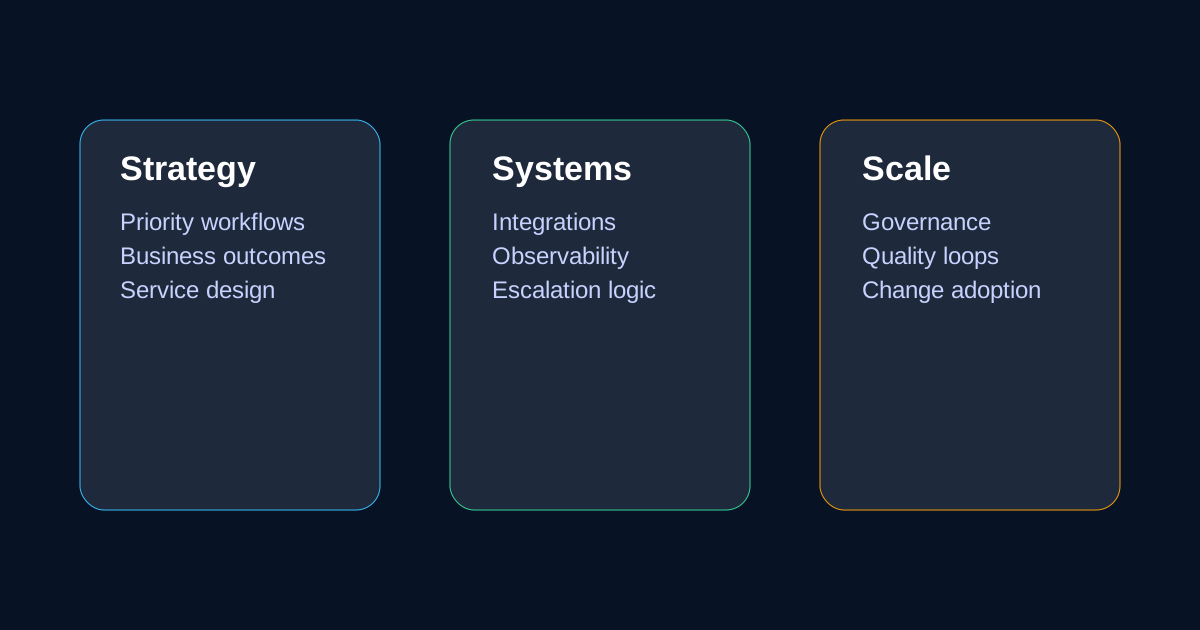
A practical enterprise maturity model
Stage 1: Controlled pilot (2 to 4 weeks)
- one workflow
- explicit fallback path
- daily QA sample
- basic KPI baseline
Stage 2: Production hardening (4 to 8 weeks)
- improve escalation accuracy
- tighten prompts and policy checks
- formalize incident runbooks
- add business-owner review cadence
Stage 3: Multi-workflow expansion
- replicate the model across adjacent workflows
- keep shared governance and measurement standards
- avoid bespoke one-off implementations per team
Metrics that actually matter
Track outcomes in four groups:
- Customer outcomes: completion rate, wait time reduction, CSAT movement
- Operational outcomes: containment, human handoff quality, callback speed
- Financial outcomes: cost per resolved interaction, recovered revenue, staffing efficiency
- Risk outcomes: policy violations, escalation misses, incident recurrence
If you only track call volume and latency, you'll miss the business picture.
Common enterprise failure patterns
“Voice quality is enough”
It is not. Voice quality helps trust, but trust breaks on wrong outcomes and weak escalation.
“We'll fix governance later”
Later usually means after an incident. Put controls in before scale.
“Let's roll out to every use case”
This creates fragmented quality and slow learning. Start narrow, then duplicate what works.
Final take
The BCG + ElevenLabs announcement is less about one vendor relationship and more about market direction: enterprise voice AI is now a cross-functional transformation program.
Teams that treat it this way will scale faster and safer than teams that treat it as a single-tool deployment.
If you want a practical rollout path, pair this with:
CTA
If you are planning an enterprise voice AI rollout, we can help you design the operating model, governance controls, and integration architecture to move from pilot to production with confidence.
Valory is a service, not software: we design, build, and manage voice AI operations so your team gets outcomes without the infrastructure burden.
Book a walkthrough or browse more guides in our articles library.
FAQ
Is this partnership relevant to mid-market companies?
Yes. The patterns BCG and ElevenLabs are codifying — governance, phased rollout, integration architecture — apply at any scale where voice AI touches customers. Mid-market teams can adopt the same discipline with lighter tooling.
Do I need to use ElevenLabs to benefit from this approach?
No. The enterprise maturity model and operating principles apply regardless of which voice AI platform you choose. The important decisions are about workflow design, controls, and measurement — not a single vendor.
How long does an enterprise voice AI rollout take?
Expect 2 to 4 weeks for a controlled pilot, 4 to 8 weeks for production hardening, and ongoing iteration after that. Teams that skip the hardening phase usually create expensive production incidents.
What is the biggest risk for enterprise voice AI programs?
Expanding scope before the first workflow is production-safe. Most failures come from scaling a demo-quality agent across multiple use cases without incident management, QA, or clear ownership.
Where should we start if we have no voice AI in place today?
Pick one high-volume, repetitive workflow — inbound enquiry triage or after-hours overflow are common starting points. Define success criteria, run a controlled pilot, and harden before expanding. The staged approach works better than a broad rollout every time.