Published: 9 February 2026 · Last updated: 11 June 2026 · Author: Matthew Walker
AI receptionist for electricians: job enquiry call flow guide
Handle quote requests, safety callouts, and after-hours electrical enquiries, with call flows, safety triage, solar and EV questions, and rollout stages.
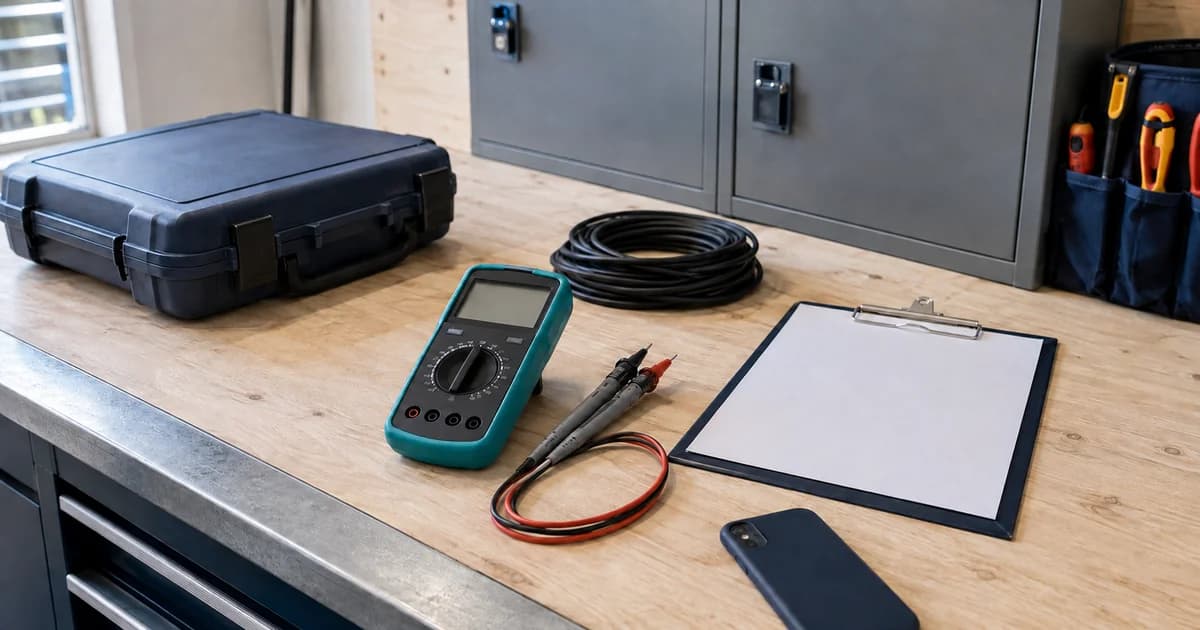
Electricians miss calls for the same reason every tradie does: they are on a job. But electrical work adds a layer — you cannot stop midway through a switchboard upgrade to take a phone call, and you should not be on the phone while working near live circuits. The calls that go unanswered while you are on site go to the sparky who picks up.
This guide covers how an AI receptionist handles the most common electrical business call types: safety callouts, quote requests for repairs and installations, solar and EV charger enquiries, compliance certificate questions, and after-hours emergencies. It includes call flows, safety triage scripts, and rollout stages specific to Australian electricians. For commercial fit on safety callouts and quote capture, see our electrician answering service page.
For the general tradies guide, see AI receptionist for tradies. For plumbing-specific flows, see AI receptionist for plumbers.
TL;DR
- Electricians are physically unable to answer calls during most of their working day — safety and compliance prevent it.
- Around 20% of calls are safety-related (no power, sparking, burning smell, tripped RCDs). These need immediate triage with a clear safety warning.
- Growth categories like solar panel installation, EV charger installation, and home battery systems are driving a new wave of high-value quote enquiries.
- According to IBISWorld, the Australian electrical services industry generated $25.2 billion in revenue in 2023–24, with over 100,000 businesses — most with fewer than 5 employees (IBISWorld Industry Report E3231).
- Average electrical job values range from $200 for a minor fault to $15,000+ for solar and EV installations. Missing quote calls costs thousands per week.
- Roll out in stages: after-hours first, then on-site overflow, then full coverage once scripts are tuned.
Why electricians lose calls
Electrical work has specific constraints that make phone answering harder than most trades:
- Safety regulations prohibit phone use near live circuits. Under AS/NZS 3000 (Wiring Rules) and state-level electrical safety regulations, electricians must maintain full attention when working on or near energised equipment. Taking a call is not just inconvenient — it is a safety risk.
- Ladder and ceiling work. A significant share of electrical work happens in roof cavities, on ladders, or in switchboard enclosures where reaching a phone is physically impractical.
- Noise and environment. Construction sites, plant rooms, and mechanical areas are too noisy for a phone conversation.
- Multi-hour jobs. Switchboard upgrades, rewires, and solar installations can take 4–8 hours of continuous work. That is half a business day where calls go unanswered.
- After hours. Power outages and safety issues happen at any time. A homeowner who loses power at 9pm is not going to wait until morning.
The cost of missed calls for sparkies
The Clean Energy Council reports over 380,000 solar installations in Australia in 2024 alone, with average residential system costs of $5,000–$12,000. Each of those installations started with a phone call or enquiry. If your electrical business is not answering, you are not quoting.
Typical electrical job values:
| Job type | Average value (AUD) |
|---|---|
| Power point install / repair | $150–$350 |
| Light fitting install | $100–$300 |
| Switchboard upgrade | $1,500–$4,000 |
| Safety switch (RCD) install | $200–$400 |
| Ceiling fan install | $200–$500 |
| Solar panel system (residential) | $5,000–$12,000 |
| EV charger installation | $1,500–$3,500 |
| Home battery system | $8,000–$16,000 |
| Full house rewire | $8,000–$20,000 |
| Test and tag (commercial) | $300–$1,500 |
| Compliance certificate | $250–$600 |
Sources: Clean Energy Council, ServiceSeeking.com.au, and industry averages, 2024.
Missing just 3 solar enquiry calls per month at an average system value of $8,000 represents $24,000 in potential lost revenue per month.
What an AI receptionist handles for electricians
1. Safety callouts (~20% of calls)
What callers describe: No power, sparking outlet, burning smell, tripped safety switch, exposed wires, buzzing switchboard.
What the AI does — critical order:
- Safety warning first: "If there is a fire, burning, or anyone is injured, please call 000 immediately."
- Assess immediate danger: "Is anyone at risk right now? Is there smoke or a burning smell?"
- Capture details: Address, what is happening, how long it has been happening, which circuits are affected, whether the safety switch keeps tripping.
- Interim guidance (where safe): "If your safety switch has tripped, try resetting it once. If it trips again immediately, leave it off — that indicates a fault."
- Send immediate SMS alert to the electrician on call.
- Confirm next step: "I have sent an urgent message. [Electrician] will call you back within [timeframe]."
Hard boundaries:
- The AI never provides electrical safety advice beyond basic "call 000" and "do not touch."
- The AI never instructs callers to inspect or touch electrical equipment.
- The AI never diagnoses electrical faults.
2. Quote requests — repairs and installations (~30% of calls)
What callers want: "How much for a switchboard upgrade?" / "Can you install a ceiling fan?" / "I need extra power points in my garage."
What the AI does:
- Identifies the job type (repair, install, upgrade, rewire).
- Captures: address, property type (residential/commercial), job description, urgency, preferred time for site visit.
- Confirms the business handles that type of work and covers the caller's area.
- Books a site visit or phone quote.
- Sends SMS confirmation.
Script example: "Pricing depends on the specific job. The best way to get an accurate quote is a site visit — most take about 30 minutes. Would you like to book a time?"
3. Solar, EV, and new technology enquiries (~15% of calls)
This is the fastest-growing call category for electricians. The Clean Energy Regulator reported a 12% increase in small-scale solar installations in Australia in 2024 compared to 2023.
What callers want: "How much for a solar system?" / "Can you install an EV charger?" / "I want a home battery."
What the AI does:
- Identifies the technology type (solar, EV charger, battery, smart home).
- Captures: property type, roof type (for solar), existing electrical setup if known, budget range if offered, preferred consultation time.
- Notes any rebates the caller asks about (the AI does not calculate rebates but can mention that the electrician will cover available incentives during the consultation).
- Books a consultation or site assessment.
Script example: "Great question. Solar system pricing depends on your roof, energy usage, and the system size. Our electrician can assess your property and walk you through options including any available rebates. Would you like to book a site assessment?"
4. Scheduling and availability (~20% of calls)
What the AI does:
- Checks calendar availability.
- Offers time windows appropriate to the job type (1-hour window for repairs, half-day for installations).
- Books and sends SMS confirmation with what the electrician will need access to.
5. FAQ and compliance questions (~15% of calls)
| Common question | Example AI response |
|---|---|
| "Are you a licensed electrician?" | "Yes, [business name] holds a current [state] electrical licence. Our licence number is [number]." |
| "Can you do a compliance certificate?" | "Yes, we can issue an Electrical Safety Certificate (ESC) / Certificate of Electrical Safety. Would you like to book an inspection?" |
| "Do you do test and tag?" | "Yes, we offer test and tag services for commercial properties. The cost depends on the number of items — would you like to book a time for us to quote?" |
| "What is an RCD / safety switch?" | "A safety switch (also called an RCD) is a device in your switchboard that protects against electric shock. If yours keeps tripping, it could indicate a fault. I can book an electrician to check it for you." |
| "Do you cover [suburb]?" | "Yes, we service [suburb]." / "That is outside our usual area — I can check and get back to you." |
What the AI must never do
- Never provide electrical safety advice beyond "call 000" and "do not touch."
- Never instruct callers to inspect electrical equipment. "Check your switchboard" — never.
- Never diagnose faults. "It sounds like a neutral fault" — never.
- Never quote exact prices without business-approved ranges.
- Never skip the safety warning for any call involving sparking, smoke, burning, or power loss.
- Never provide advice on DIY electrical work. All electrical work in Australia must be performed by a licensed electrician (state electrical safety legislation).
Rollout plan for electrical businesses
Stage 1: After-hours and weekends (weeks 1–3)
Forward calls to the AI outside business hours. Captures emergency calls and evening/weekend quote enquiries.
Configure: Safety triage flow, quote capture, service area, FAQ, SMS alerts.
For setup: Call forwarding guide.
Stage 2: On-site overflow (weeks 4–6)
Route calls to the AI when you are on a job. This is where the biggest volume of missed calls occurs.
Stage 3: Full coverage (week 7+)
All calls go to the AI first. Safety issues escalate immediately. Quotes are captured and queued for callback between jobs.
Risk controls
| Risk | Control |
|---|---|
| Safety call not escalated | Safety keywords (sparking, fire, no power, shock, burning) trigger immediate triage + 000 warning |
| DIY advice given | Explicit forbidden-topic list; all technical questions redirect to booked site visit |
| Licence claim error | Licence details provided by business; AI reads from approved script only |
| Price misquote | Approved ranges only; all specific quotes require site assessment |
| Solar rebate miscommunicated | AI mentions rebates exist but never calculates amounts; directs to consultation |
Cost comparison
| Option | Annual cost | Coverage | Lead capture | Safety handling |
|---|---|---|---|---|
| Office admin / partner answering | $0 (but opportunity cost) | Sporadic | Inconsistent | Variable |
| Virtual receptionist | $3,600–$10,800 | Business + limited AH | Script-based | Limited |
| AI receptionist | $1,800–$6,000 | 24/7 | Structured | Immediate triage + SMS |
Related guides
- AI receptionist for tradies — general trade business call flows.
- AI receptionist for plumbers — plumbing-specific emergency and quote flows.
- After-hours call handling for Australian SMEs — off-hours call flow.
- Missed calls cost: estimate lost revenue fast — quantify missed calls.
- How much does a receptionist cost in Australia? — compare hiring options.
- Best AI receptionist services in Australia — compare providers.
- Call forwarding guide — set up forwarding to an AI receptionist.
- IVR phone menus vs AI receptionist — if you use an IVR now.
FAQ
Can an AI receptionist handle electrical emergency calls?
Yes. The AI recognises safety keywords (no power, sparking, burning smell, exposed wires) and immediately provides a safety warning ("Call 000 if there is fire or injury"). It captures the caller's address and details, then sends an urgent SMS to the electrician on call. It never provides technical advice or instructs callers to touch electrical equipment.
How does the AI handle solar enquiries?
The AI captures the property type, roof details (if offered), energy usage interest, and budget range. It mentions that rebates and incentives are available and that the electrician will cover these during a site assessment. It then books a consultation. It does not calculate rebate amounts or quote system prices without approved ranges from the business.
Will it work with my job management software?
Common platforms for electricians include ServiceM8, Simpro, AroFlo, and Tradify. Calendar integration (Google, Outlook) is standard. If direct integration is not available, the AI sends structured job details via SMS or email for manual entry.
Can the AI answer compliance certificate questions?
Yes. It can explain what an Electrical Safety Certificate is, confirm that the business issues them, and book an inspection. It does not assess whether a property requires a certificate or provide compliance advice — that is the electrician's responsibility during the inspection.
How much does it cost?
$149–$499 per month depending on call volume. For an electrician losing 3 solar enquiries per month (average system value $8,000), the AI pays for itself by capturing even one additional lead.
Is it licensed to give electrical advice?
No — and it never does. The AI is a phone answering and booking tool. All technical questions are redirected to a booked site visit with the licensed electrician. This is a non-negotiable boundary in the system's configuration.
Next step
If you want to see how an AI receptionist handles your quote requests, emergency calls, and solar enquiries, we can walk through your call types in 15 minutes.
Book a walkthrough or browse more guides in our resources library.