Published: 17 February 2026 · Last updated: 11 June 2026 · Author: Matthew Walker
AI receptionist for plumbers: job enquiry call flow guide
Handle emergency callouts, quote requests, and job bookings while on site or after hours, with call flows, triage, lead capture, and risk controls.
Plumbing calls land at the worst possible time: when you are under a house, elbow-deep in a job, or driving between sites. Every missed call is a job that goes to the next plumber on Google. And in plumbing, a significant share of calls are emergencies — burst pipes, gas leaks, flooding — where the caller will not wait and will not leave a voicemail.
This guide covers how an AI receptionist handles the most common plumbing call types: emergency callouts, quote requests, scheduling, service area questions, and existing job follow-ups. It includes call flows, emergency triage scripts, lead capture templates, rollout stages, and risk controls specific to Australian plumbing businesses. For commercial coverage on quote capture and after-hours callouts, see our plumber answering service page.
For the general tradies guide, see AI receptionist for tradies. To compare receptionist options, see How much does a receptionist cost in Australia?.
TL;DR
- Plumbers miss calls because they are physically unable to answer — on the tools, on a roof, under a floor, or driving. This is structural, not a staffing failure.
- Around 25% of plumbing calls are emergencies (burst pipes, gas leaks, flooding). These need immediate triage — not voicemail.
- The remaining 75% (quotes, scheduling, service area, FAQs) follow patterns an AI receptionist handles consistently.
- Emergency triage must include a gas leak safety warning ("Call 000 and leave the property") before anything else.
- Average plumbing job values in Australia range from $200 for a minor repair to $5,000+ for hot water replacement or bathroom renovations (ServiceSeeking, 2024). Missing five quote calls per week could cost $2,000–$10,000 in lost revenue.
- Roll out in stages: after-hours first, then on-site overflow, then full coverage once scripts are tuned.
Why plumbers lose more calls than most trades
Plumbing has a unique call pattern. Unlike an office-based business where someone can always pick up, plumbing work physically prevents you from answering:
- Under the house or in a roof cavity — no reception, hands dirty, can't reach the phone.
- Mid-job with water flowing — you cannot stop to take a call.
- Driving between jobs — hands-free helps, but you cannot capture details or check the calendar.
- Emergency response — when you are responding to one burst pipe, five other callers are trying to reach you.
- After hours — emergencies do not wait for business hours. A burst pipe at 10pm needs someone now.
The numbers
According to the Australian Bureau of Statistics, there were approximately 82,800 plumbing businesses operating in Australia in 2023 (ABS 8165.0, Counts of Australian Businesses). The majority are sole traders or businesses with fewer than 5 employees — meaning there is often nobody to answer the phone when the plumber is on a job.
Industry data from ServiceSeeking (Australia's largest trades marketplace) shows average plumbing job values:
| Job type | Average value (AUD) |
|---|---|
| Tap repair / replacement | $180–$350 |
| Blocked drain | $200–$500 |
| Toilet repair / replacement | $250–$600 |
| Hot water system replacement | $1,500–$3,500 |
| Burst pipe repair | $300–$800 |
| Bathroom renovation (plumbing) | $3,000–$8,000 |
| Gas fitting | $200–$600 |
| General maintenance call | $150–$350 |
Source: ServiceSeeking.com.au average quotes, 2024.
If a plumber misses 5 quote calls per week at an average job value of $400, that is $2,000 per week or $104,000 per year in potential lost revenue. Even converting half of those calls yields $52,000.
What an AI receptionist handles for plumbers
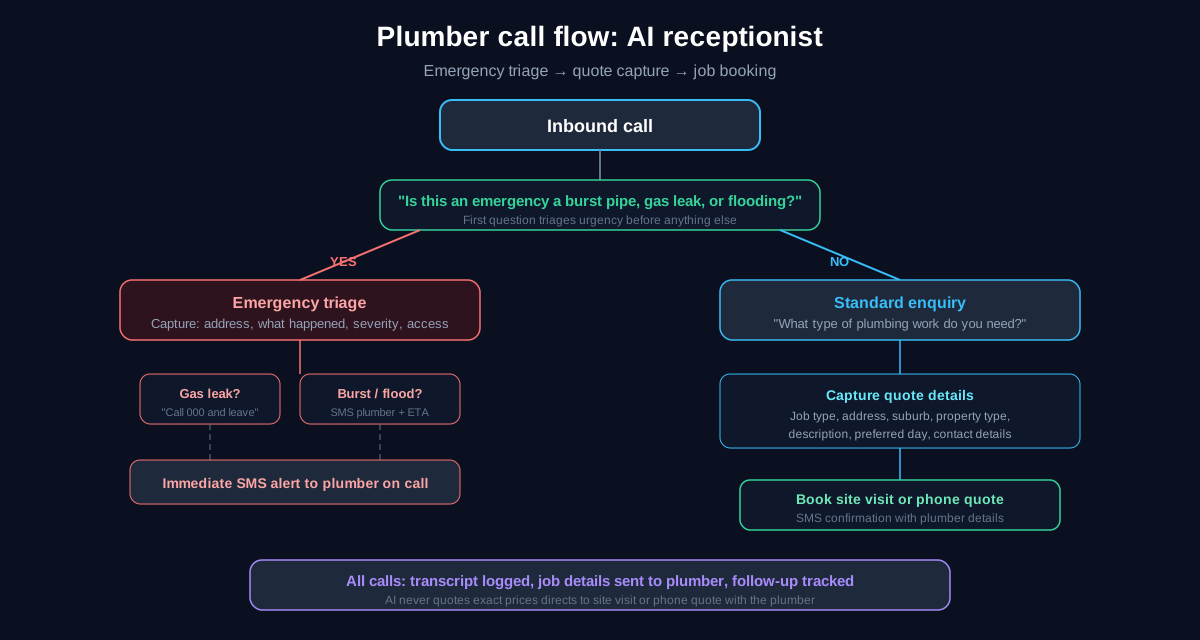
1. Emergency callouts (~25% of calls)
What callers describe: Burst pipe, flooding, no hot water, gas smell, overflowing toilet, sewer backup.
What the AI does — critical order:
- Gas leak check first. If the caller mentions gas, the AI immediately says: "If you can smell gas, please leave the property immediately and call 000. Do not use any electrical switches. Once you are safe, call us back and we will send a plumber urgently."
- Capture urgency details: Address, what is happening, how long it has been happening, property type (house/unit/commercial), and whether water is still flowing or has been isolated.
- Send immediate SMS alert to the plumber on call with all captured details.
- Provide interim guidance where safe: "If you can locate the main water shut-off valve, turning it off will stop the flooding until the plumber arrives."
- Confirm next step: "I have sent an urgent message to [plumber name]. They will call you back within [timeframe]. If the situation worsens, call 000."
Hard boundaries:
- The AI never provides technical plumbing advice.
- The AI never estimates repair costs for emergencies.
- Gas-related calls always start with a safety warning and 000 referral.
2. Quote requests (~30% of calls)
What callers want: "How much to fix a dripping tap?" / "Can you do a hot water replacement?" / "I need a plumber for a bathroom reno."
What the AI does:
- Identifies the job type (repair, replacement, installation, renovation).
- Captures: address, suburb, property type, job description, urgency level, preferred day/time for a site visit or phone quote.
- Confirms service area coverage.
- Offers to book a site visit or phone quote.
- Sends SMS confirmation with plumber details.
Script example for pricing: "Pricing depends on the job once our plumber has had a look. The quickest way to get an accurate quote is a site visit — there is no charge for the quote itself. Would you like to book a time?"
Hard boundary: The AI never quotes specific prices. It can say "A [job type] typically ranges from $X to $Y depending on the specifics — our plumber will confirm after assessing the job" only if the business has provided approved price ranges.
3. Scheduling and availability (~20% of calls)
What callers want: Book a time, check availability, confirm an existing booking.
What the AI does:
- Checks calendar availability (if integrated).
- Offers available time windows.
- Books and sends SMS confirmation.
- For existing bookings: confirms date, time, and what the plumber will need access to.
4. Service area and FAQ (~15% of calls)
| Common question | Example AI response |
|---|---|
| "Do you service [suburb]?" | "Yes, we cover [suburb] and the surrounding area." / "That is outside our usual service area. I can check with the plumber and get back to you." |
| "Are you licensed?" | "Yes, we hold a current Queensland plumbing licence [number]. Our licence covers [scope]." |
| "Do you do gas fitting?" | "Yes, our plumber is a licensed gas fitter." / "We don't do gas fitting, but I can recommend [referral]." |
| "What are your hours?" | "We are available Monday to Friday [hours] and Saturday [hours]. For emergencies, we have an after-hours service." |
| "Do you charge a call-out fee?" | "There is a call-out fee of $[X] which is applied to the job if you go ahead with the work." |
5. Existing job follow-up (~10% of calls)
What callers want: Update on a scheduled job, change a booking, report an issue with completed work.
What the AI does:
- Captures the caller's name and job details.
- Sends a message to the plumber with the follow-up request.
- Confirms the message has been sent.
What the AI must never do
- Never provide technical plumbing advice. "Try tightening the valve yourself" — never.
- Never diagnose a problem. "It sounds like your hot water system is failing" — never.
- Never quote exact prices without approval. Only approved price ranges from the business.
- Never downplay an emergency. All emergencies escalate immediately. The AI does not decide severity.
- Never skip the gas safety warning. Any mention of gas triggers the safety script before anything else.
Rollout plan for plumbing businesses
Stage 1: After-hours and weekends (weeks 1–3)
Forward calls to the AI outside business hours. This captures the emergency calls and quote enquiries that currently go to voicemail.
What to configure:
- Emergency triage flow with gas safety warning.
- Quote capture template with job type, address, and preferred time.
- Service area list.
- FAQ responses (licensing, hours, call-out fees).
- SMS alert to on-call plumber for emergencies.
For setup: Call forwarding guide.
Stage 2: On-site overflow (weeks 4–6)
Route calls to the AI when you are on a job and cannot answer. This catches the calls lost during your busiest work hours.
Stage 3: Full coverage (week 7+)
All inbound calls go to the AI first. Emergencies escalate immediately. Quote requests are captured and sent to you with full details. You call back between jobs with all the context you need.
Risk controls
| Risk | Control |
|---|---|
| Gas emergency not handled safely | Gas keyword triggers safety warning + 000 referral before any other response |
| Emergency downplayed | All urgency keywords (burst, flood, leak, gas, sewage) trigger immediate escalation |
| Inaccurate pricing | AI uses approved price ranges only; directs to site visit for accurate quote |
| Service area confusion | Approved suburb list; unclear areas flagged for plumber to confirm |
| Licensing claim error | Licence details provided by business; AI reads from approved script |
Cost comparison for plumbers
| Option | Annual cost | Coverage | Lead capture | Emergency handling |
|---|---|---|---|---|
| Apprentice answering phone | $45,000–$55,000 | Business hours | Variable | Inconsistent |
| Virtual receptionist | $3,600–$10,800 | Business + limited AH | Script-based | Limited |
| AI receptionist | $1,800–$6,000 | 24/7 | Structured | Immediate triage + SMS |
For a full cost comparison, see How much does a receptionist cost in Australia?.
Related guides
- AI receptionist for tradies — general trade business call flows.
- AI receptionist for electricians — electrical-specific call flows.
- After-hours call handling for Australian SMEs — the call flow for off-hours.
- Missed calls cost: estimate lost revenue fast — quantify your missed call problem.
- How much does a receptionist cost in Australia? — compare all hiring options.
- Best AI receptionist services in Australia — compare providers.
- Call forwarding guide — set up forwarding to an AI receptionist.
- AI receptionist vendor checklist — 25 questions before you sign.
FAQ
Can an AI receptionist handle plumbing emergency calls?
Yes. The AI triages emergencies by asking about the nature of the issue (burst pipe, gas, flooding), capturing the address and details, and sending an immediate SMS alert to the plumber on call. For gas-related calls, it provides a safety warning ("Call 000 and leave the property") before anything else. It does not attempt to provide technical advice or assess severity — all emergencies escalate immediately.
Will customers know they are talking to AI?
Most AI receptionists include a brief disclosure. The experience is conversational — callers describe their issue in their own words, and the AI responds naturally. For emergency callers, the priority is getting help fast, and most care more about that than who answered.
How does the AI handle quote requests?
The AI captures the job type, address, description, and preferred time, then offers to book a site visit or phone quote. It does not quote specific prices unless the plumber has provided approved price ranges (e.g., "A blocked drain typically costs $200–$500 depending on the job"). For accurate quotes, it directs callers to a site visit.
Can it integrate with job management software?
Integration depends on the provider. Common platforms for plumbers include ServiceM8, Simpro, AroFlo, and Fergus. Calendar integration (Google, Outlook) is standard. If direct integration is not available, the AI sends structured job details to the plumber for manual entry.
How much does it cost?
AI receptionist services for plumbers typically cost $149–$499 per month — roughly $5–$16 per day. For a plumber losing 5+ jobs per week to missed calls, the AI pays for itself by capturing even one or two extra jobs per month.
What about gas fitting calls — are there special rules?
Yes. Any mention of gas triggers a mandatory safety protocol: the AI advises the caller to leave the property and call 000 if they smell gas. This happens before any details are captured. Once the caller confirms they are safe, the AI proceeds with emergency triage and alerts the plumber.
Next step
If you want to see how an AI receptionist handles your most common call types, we can walk through your service area, job categories, and emergency triage in a 15-minute call.
Book a walkthrough or browse more guides in our resources library.