Published: 3 February 2026 · Last updated: 24 May 2026 · Author: Matthew Walker
AI receptionist for property management: implementation guide
Implementation guide for property management AI receptionist rollout: maintenance triage, leasing flows, after-hours emergencies, and risk controls.

Implementation guide
This page explains rollout steps, call flows, and risk controls for property management agencies. For commercial coverage, pricing context, and how Valory fits your team, start on the industry landing page.
Commercial fit: If you are choosing a provider, start with the property management answering service (Australia) page for coverage, pricing context, and agency fit.
This guide covers implementation: maintenance triage, leasing flows, after-hours emergencies, and rollout stages once you are ready to configure live call handling.
Property management agencies answer more phone calls per staff member than almost any other service business. Tenants call about maintenance. Prospective tenants call about listings. Landlords call about their investment. Trades call about access. And most of these calls come in while property managers are at inspections, in meetings, or handling another call.
The result: voicemails pile up, tenants feel ignored, landlords lose confidence, and prospective tenants apply somewhere else. It is not a people problem — it is a volume problem.
Below we walk through the most common property management call types: maintenance requests (routine and emergency), leasing enquiries, tenant FAQs, landlord messages, and after-hours emergencies — with triage flows, capture templates, rollout stages, and risk controls.
For the real estate sales guide, see AI receptionist for real estate. To compare receptionist options, see How much does a receptionist cost in Australia?.
TL;DR
- Property management generates high call volume across multiple caller types (tenants, landlords, prospects, trades). The ratio of calls to staff is often 80–120+ calls per property manager per week.
- Around 35% of inbound calls are maintenance requests. Most follow a predictable pattern that an AI captures better than a voicemail.
- Emergency maintenance (flooding, fire, lock-out, no hot water in winter) needs immediate triage — not a message that sits until morning.
- Leasing enquiries from prospective tenants are time-sensitive. According to CoreLogic, national rental vacancy rates in Australia sat at 1.3% in late 2024 — the tightest in decades. In that market, the first agency to respond captures the application.
- Property management software integration (PropertyMe, Console Cloud, MRI, Rex) determines how much the AI can automate directly vs capturing for staff.
- Roll out in stages: after-hours first, then maintenance overflow, then full coverage.
Why property management agencies struggle with phones
The call volume problem
A typical property manager handles 80–150 properties. Each property generates 1–3 calls per month minimum (maintenance, lease questions, inspections, rent). That is 80–450 calls per month per property manager — on top of inspections, lease negotiations, tribunal preparation, and landlord reporting.
The Real Estate Institute of Australia (REIA) and state-level bodies regularly cite workload as the primary driver of property management staff turnover, which runs at 30–40% annually in many agencies (REIA Property Management Survey, 2023).
When calls go unanswered
- During inspections — property managers spend 2–3 hours per day off-site at routine and entry/exit inspections.
- Morning rush — 9–11am is peak call time (tenants calling before work, landlords catching up, trades coordinating access).
- After hours — emergency maintenance calls (burst pipes, lock-outs, no hot water) happen evenings and weekends.
- Lunch break — if there is one receptionist, the phone is unmanned for 30–60 minutes.
- Staff turnover — when a property manager leaves, their portfolio's calls go unanswered during handover.
The cost of missed PM calls
Missed calls in property management have two costs:
-
Tenant dissatisfaction → landlord churn. If tenants feel ignored, they complain to the landlord. If the landlord hears about slow maintenance responses, they move to a competitor agency. Losing a management authority on a $600/week rental (management fee ~7%) costs the agency approximately $2,184 per year in recurring revenue — and the cost of acquiring a replacement landlord.
-
Lost leasing revenue. In a tight rental market, prospective tenants call multiple agencies. The first to answer, book an inspection, and process an application wins. A missed leasing call in a 1.3% vacancy market is a lost letting fee (typically 1–2 weeks rent = $600–$1,200).
What an AI receptionist handles for property management
Property management has clearly segmented caller types. The AI needs different scripts for each.
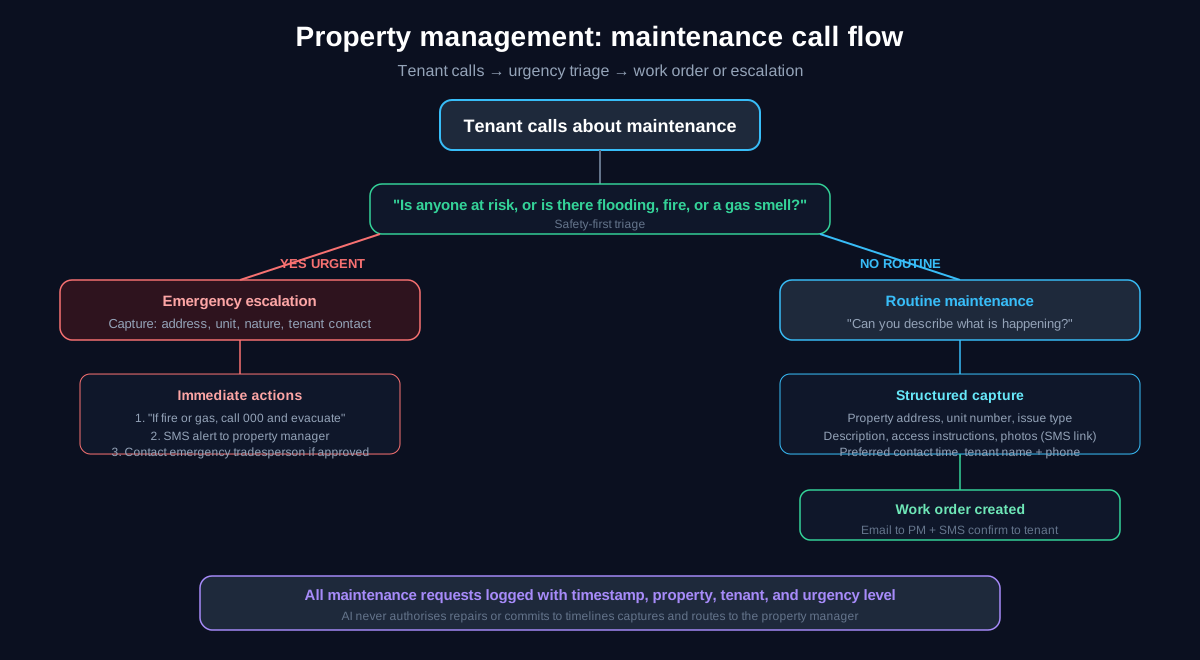
1. Maintenance requests — routine (~25% of calls)
What tenants report: Dripping tap, broken blind, oven not working, fence damage, mould, pest issue, air conditioning fault.
What the AI does:
- Identifies the caller as a tenant (confirms property address and name).
- Captures: property address, unit number, description of the issue, how long it has been occurring, preferred contact time, and access instructions (is someone home during the day? Is there a lock box?).
- Offers to send a photo upload link via SMS so the tenant can attach images of the issue.
- Classifies urgency (routine, soon, urgent) based on the description.
- Creates a structured work order and sends it to the property manager via email or directly into the property management system.
- Confirms to the tenant: "I have logged your maintenance request. Your property manager will review it and arrange a tradesperson. You will hear back within [business's stated SLA, e.g., 2 business days]."
Hard boundary: The AI never authorises repairs, commits to timelines, or promise a specific tradesperson. It captures and routes.
2. Maintenance requests — emergency (~10% of calls)
What tenants report: Flooding, burst pipe, no hot water (in winter with children), fire damage, gas smell, lock-out, security breach.
What the AI does:
- Safety first: "If there is a fire or gas smell, please call 000 and evacuate immediately."
- Capture: Property address, unit, what is happening, is anyone at risk.
- Immediate SMS alert to the property manager and/or after-hours emergency contact.
- Contact emergency tradesperson if the agency has pre-approved emergency contractors (e.g., plumber for burst pipes, locksmith for lock-outs).
- Interim guidance where safe: "If you can locate the main water shut-off, turning it off will help until the plumber arrives."
- Confirm: "I have sent an urgent message and contacted the emergency plumber. They will call you shortly."
Under the Residential Tenancies Act in each state, landlords and agents have obligations to address urgent repairs within specific timeframes (e.g., 24–48 hours in most jurisdictions). The AI helps meet these obligations by ensuring urgent issues are captured and escalated immediately — even at 11pm on a Saturday.
3. Leasing enquiries (~20% of calls)
What callers want: "Is [address] still available?" / "Can I book an inspection?" / "What is the application process?"
What the AI does:
- Confirms the property is still available (if integrated with listings data) or captures the address and confirms a callback.
- Captures: caller name, phone, email, number of occupants, move-in timeline, pets.
- Books an inspection time (if calendar integration allows).
- Sends SMS with inspection details, address, and application link.
- Notes any specific questions (parking, pets, lease length) for the property manager.
Why speed matters: CoreLogic's December 2024 rental review showed national vacancy rates at 1.3%, with Sydney at 1.5% and Brisbane at 1.0%. Properties are leasing within days of listing. The agency that responds first to an inspection request captures the applicant. An AI that answers at 8pm on a Tuesday night while the property manager is at dinner converts calls that voicemail does not.
4. Tenant FAQs (~15% of calls)
| Common question | Example AI response |
|---|---|
| "When is my lease up?" | "I do not have access to your specific lease details, but I can ask your property manager to confirm. Can I take your name and the property address?" |
| "How do I pay rent?" | "Rent payments are made through [platform, e.g., PropertyMe, DEFT]. I can send you the details via SMS." |
| "Can I have a pet?" | "Pet approval depends on your lease terms and the landlord's consent. I can log a request for your property manager to review." |
| "When is my next inspection?" | "I can check on that for you. Let me take your details and your property manager will confirm the date." |
| "How do I give notice?" | "Notice requirements depend on your lease type. Generally, you need to provide [X weeks] written notice. Your property manager can confirm the exact requirements for your situation." |
| "I have not received my bond back." | "Bond refunds are processed through the state bond authority. I will ask your property manager to follow up. Can I confirm your name and property address?" |
Hard boundary: The AI never provides specific lease interpretations or legal guidance on tenancy matters. It captures the question and routes to the property manager.
5. Landlord and owner calls (~15% of calls)
What landlords want: Speak to their property manager, get an update on a vacancy, ask about a maintenance cost, query a statement.
What the AI does:
- Identifies the caller as a landlord (by name and property address).
- Captures the message: who they need, what it is regarding, urgency.
- Sends the message to the assigned property manager via SMS or email.
- Confirms: "I have sent a message to [PM name]. They will get back to you as soon as possible."
Hard boundary: The AI never provides financial details, discusses pending maintenance costs, or shares tenant information with a landlord. All substantive questions route to the property manager.
What the AI must never do
- Never authorise repairs or commit to timelines. "We will have a plumber there tomorrow" — never.
- Never provide legal guidance on tenancy matters. Lease interpretation, notice periods, bond disputes — always route to PM.
- Never share tenant information with landlords. Even if the landlord owns the property.
- Never share landlord information with tenants. The property manager manages this relationship.
- Never discuss rent arrears. Rent collection and arrears management require human judgement and privacy.
- Never downplay emergency maintenance. All potential emergencies escalate immediately.
Integration with property management software
| System | Integration path | What it enables |
|---|---|---|
| PropertyMe | API | Create maintenance requests, read property data |
| Console Cloud | API | Create work orders, access tenant records |
| MRI (formerly Palace) | API (varies) | Property lookup, maintenance logging |
| Rex | API | Contact lookup, activity logging |
| Google Calendar | Native | Book inspections, schedule callbacks |
If direct integration is not available, the AI sends structured emails to the property manager with all captured details — far more useful than decoding a voicemail.
Rollout plan for property management
Stage 1: After-hours only (weeks 1–3)
Forward calls to the AI outside business hours. This captures emergency maintenance and leasing enquiries that currently go to voicemail.
Configure: Emergency triage, routine maintenance capture, leasing enquiry capture, FAQ responses, SMS escalation for emergencies.
For setup: Call forwarding guide.
Stage 2: Maintenance overflow (weeks 4–6)
Route maintenance calls to the AI during business hours when staff are at inspections or on other calls.
Stage 3: Full coverage (week 7+)
All inbound calls go to the AI first. Emergencies escalate immediately. Routine maintenance is logged as structured work orders. Leasing enquiries are captured and inspection bookings confirmed. Property managers review and action the queue between inspections.
Risk controls
| Risk | Control |
|---|---|
| Emergency maintenance not escalated | Urgency keywords (flood, fire, gas, lock-out, no hot water + children) trigger immediate SMS escalation |
| Repair authorised by AI | AI never authorises work; captures and routes only |
| Tenant/landlord info shared incorrectly | Strict caller-type segregation; AI never shares cross-party information |
| Legal advice given | All tenancy law questions redirect to property manager |
| Vacant property not shown | Leasing enquiries captured with inspection booking; speed of response tracked |
| Landlord frustrated by AI | Landlord calls flagged as high priority; option for immediate SMS to PM |
Cost comparison for property management
| Option | Annual cost | Coverage | Maintenance capture | After-hours emergency |
|---|---|---|---|---|
| Dedicated receptionist (FT) | $65,000–$85,000 | Business hours | Verbal/manual | None |
| Virtual receptionist | $3,600–$10,800 | Business + limited AH | Script-based | Limited |
| AI receptionist | $1,800–$6,000 | 24/7 | Structured work orders | Immediate triage + SMS |
For a full breakdown, see How much does a receptionist cost in Australia?.
Related guides
- AI receptionist for real estate — sales-side call flows for real estate.
- After-hours call handling for Australian SMEs — off-hours call flow.
- Missed calls cost: estimate lost revenue fast — quantify the problem.
- How much does a receptionist cost in Australia? — compare hiring options.
- Best AI receptionist services in Australia — compare providers.
- AI receptionist vendor checklist — 25 questions before you sign.
- Call forwarding guide — route your agency number to an AI receptionist.
- Peak period phone calls: triage without burnout — manage volume spikes.
- AI phone agents in Australia: privacy and call recording — consent and disclosure.
FAQ
Where do I compare property management answering service options?
For commercial coverage and how Valory fits Australian agencies, use the property management answering service (Australia) page. This guide covers tenant call flows, maintenance triage, and rollout — not plan selection.
Can an AI receptionist handle emergency maintenance calls?
Yes. The AI recognises urgency keywords (flooding, fire, gas, lock-out, no hot water) and immediately captures the tenant's details and property address. It sends an SMS alert to the property manager and can contact pre-approved emergency tradespeople (plumber, locksmith) if configured. It provides safety guidance ("Call 000 if there is fire or gas") but never authorises repairs or commits to timelines.
Will tenants accept talking to an AI?
Most tenants care about getting their issue logged and acted on quickly. An AI that answers immediately, captures details properly, and confirms "Your request has been logged and your property manager will review it" is a better experience than leaving a voicemail that may not be checked until the next day. For sensitive issues, the AI escalates to the property manager directly.
How does the AI handle leasing enquiries?
The AI confirms availability (if integrated with listings), captures the prospective tenant's details (name, contact, occupants, pets, move-in timeline), and books an inspection. It sends an SMS with the inspection details and application link. In a market with 1.3% vacancy rates, the speed advantage of answering at 8pm vs calling back the next morning is significant.
Can it log maintenance into PropertyMe or Console Cloud?
Integration depends on the provider. PropertyMe and Console Cloud both have APIs that support creating maintenance requests. If direct integration is not available, the AI sends a structured email with all details (property, tenant, issue, urgency, photos) for manual entry — still significantly faster than transcribing a voicemail.
How does the AI handle landlord calls?
Landlord calls are identified and treated as high priority. The AI captures the landlord's name, property, and the nature of their call, then sends an immediate message to the assigned property manager. It never provides financial information, discusses maintenance costs, or shares tenant details with the landlord.
Will it handle calls from tradespeople?
Yes. The AI can capture messages from tradespeople regarding access, job completion, quotes, and scheduling. It routes these to the relevant property manager with the property address and trade type for context.
How much does it cost?
AI receptionist services for property management agencies typically cost $149–$499 per month. For an agency managing 100+ properties and fielding 300+ calls per month, the AI reduces the need for additional reception staff ($65,000–$85,000/year) while providing 24/7 coverage.
What about privacy — tenant data is sensitive?
The AI captures only the information needed to log and route the request (name, address, issue description). It does not access lease documents, financial records, or personal information beyond what the tenant provides in the call. Call data should be encrypted, access-controlled, and handled under documented retention and deletion rules. For detailed guidance, see AI phone agents in Australia: privacy and call recording.
Next step
If you want to see how an AI receptionist handles your agency's maintenance calls, leasing enquiries, and after-hours emergencies, we can walk through your portfolio and triage rules in 15 minutes.
Book a walkthrough or browse more guides in our resources library.