Published 21 October 2026
From enquiry to appointment: what 24 service-business websites advertise
A public-source study of advertised contact routes, booking wording and response expectations across 24 plumbing, dental and accounting businesses in four Australian cities.
Want this analysis applied to your business?
Bring your call volume and current workflow. We will help map missed-call leakage, automation fit, and the safest rollout path.
Book a walkthroughInitial collection 20 October 2026; limited source corroboration 21 October. Published 21 October 2026.
Evidence: public website text; search-based convenience sample; three industries and four Australian metros.
Produced by: Valory AI. No business was called or sent an enquiry.
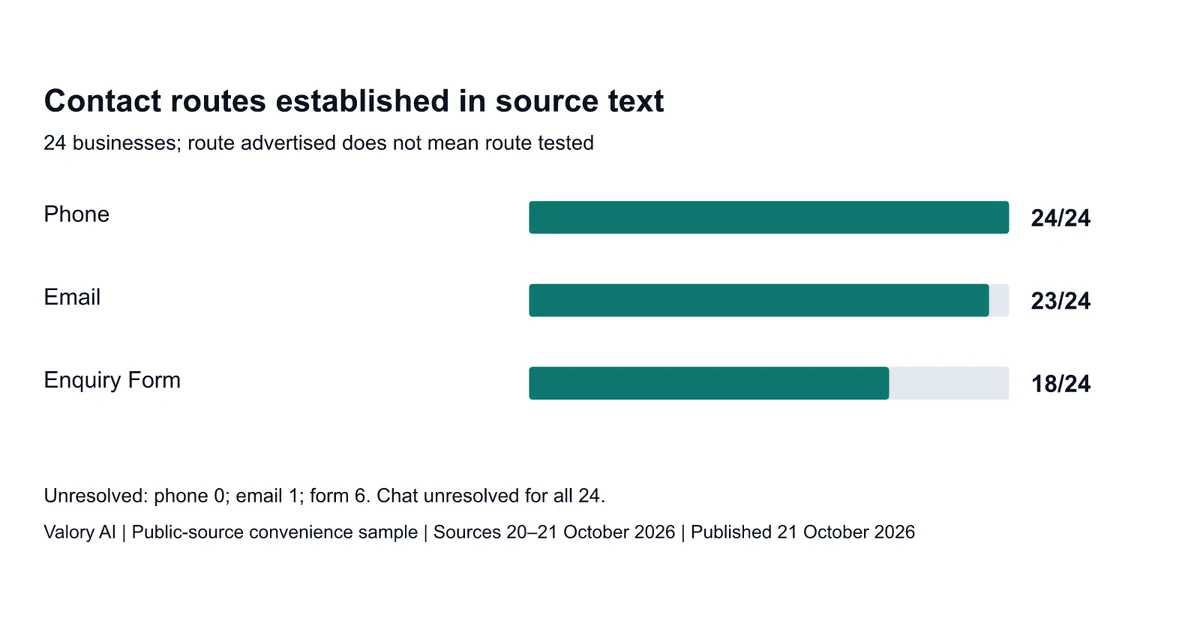
Contact options were easy to establish in this small sample: all 24 businesses advertised a phone route, 23 advertised an email route, and 18 advertised an enquiry or request form. The next step was more varied. Some pages described staff confirmation, some described online scheduling, and others offered a booking label without enough extracted detail to establish the process.
Only two businesses had a specific written-enquiry response timeframe established in the pages inspected. Another six made a general follow-up promise. The other 16 are unknown, rather than businesses proven to have no response expectation.
These counts describe the source text collected for these 24 businesses. They do not estimate Australian prevalence, show whether contact routes work, or measure actual reply speed, missed calls, bookings or revenue.
What we inspected
We selected two distinct business brands in each of 12 cells: plumbing, dental and accounting across Sydney, Melbourne, Brisbane and Perth. Each industry contributes eight businesses; each metro contributes six. Selection followed the first eligible results returned for each predefined industry/metro/contact query, with duplicate brands and failed accesses recorded. The balanced cells were a design choice, not population weights.
The unit is the business brand's inspected public presence. A multi-location brand enters once; brands are not guaranteed to have independent ownership. One university-linked dental service operated by a company is included. This is not a sample restricted to small, independently owned firms.
The collection inspected at most two distinct primary pages for an included business, below the method's three-page ceiling. Supplementary HTTP reads and later independent review revisited selected source URLs. External booking destinations were identified from links but not opened. Forms, calendars, phones and chat were not exercised.
The method hash accompanies the frozen method, selection log, business-level CSV, source register, per-field evidence cues and calculations.
Contact routes commonly appeared together
| Advertised route established in inspected text | Count | Unknown within scope | Denominator |
|---|---|---|---|
| Phone | 24 | 0 | 24 |
| 23 | 1 | 24 | |
| Enquiry or request form | 18 | 6 | 24 |
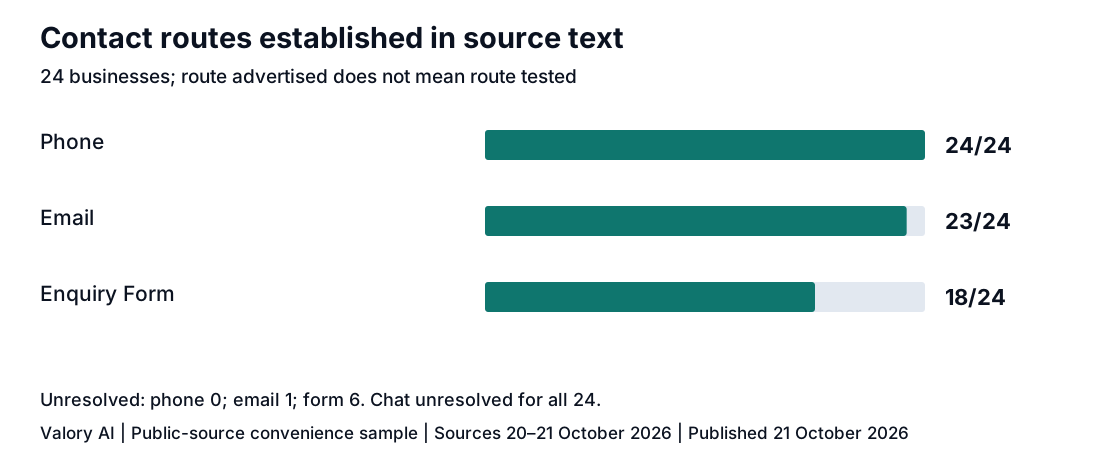
A positive email code means that a channel was advertised. It does not establish that an address was readable or working. For example, Accounting House's extracted page described an email channel while asking the reader to enable JavaScript to reveal the address. A phone number in text likewise does not prove that a call would connect.
Chat remains unknown for all 24 businesses. Text access is not a reliable way to rule out a dynamic widget; a social-messaging invitation is not evidence that an on-site live-chat service exists. There is no finding here that these businesses lack chat.
A booking label did not always explain the process
| Predefined classification | Count / 24 |
|---|---|
| Direct scheduling expressly advertised | 3 / 24 |
| Request followed by staff action advertised | 6 / 24 |
| Both routes advertised | 1 / 24 |
| Booking label only; process unresolved | 10 / 24 |
| No classification established | 4 / 24 |
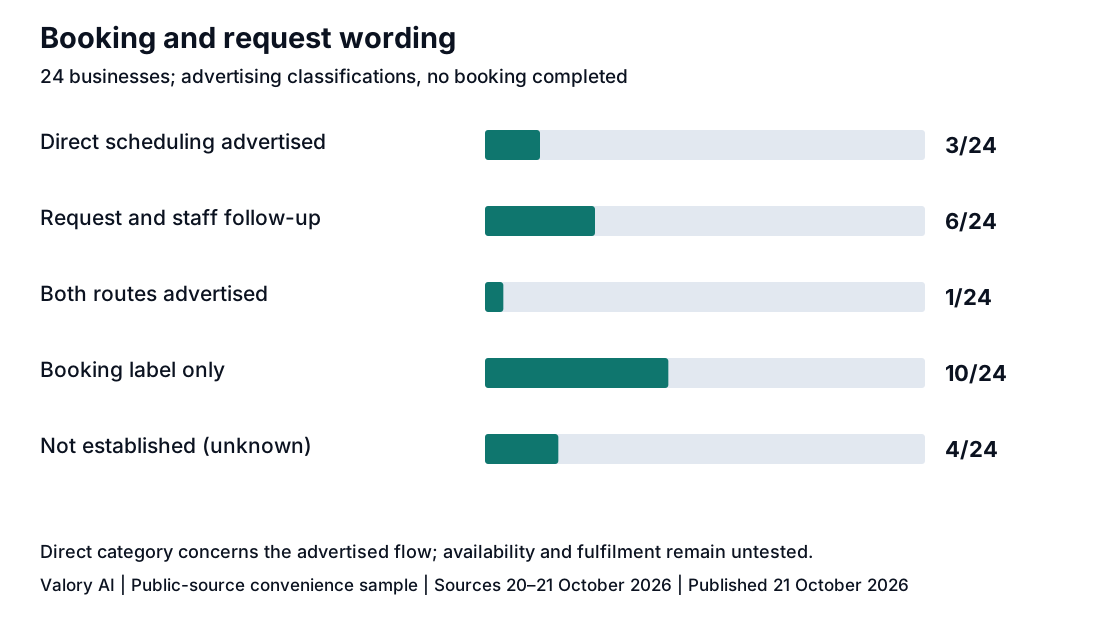
These are deliberately conservative advertising classifications. They are not counts of working booking systems.
Brisbane Plumbing and Drainage described choosing a preferred time followed by business confirmation. That supports the request classification, even though the page also used online-booking language. National Plumbing Australia advertised automatic allocation to a nearby available time if the requested time was unavailable. That supports the direct-scheduling advertising classification, with no claim that the requested slot would be delivered.
CBD Dental Sydney described selecting a treatment and finding a suitable time, which also establishes advertised direct scheduling. MC Dental's locations page explicitly directed visitors through online appointment prompts. Brisbane CBD Dental Clinic advertised an online booking tool and a separate request awaiting confirmation. Its page also warned that its online system was being updated and offered a phone fallback. We did not test that tool, so the warning is not a finding of failure.
Ten other inspected presences contained booking labels without enough extracted information to classify the process. Some may have fully working scheduling behind a button or script. The study does not resolve that question.
Response wording was less often established than contact details
| Written-enquiry wording | Count / 24 |
|---|---|
| Specific advertised timeframe | 2 / 24 |
| General follow-up promise | 6 / 24 |
| Unknown within inspected text | 16 / 24 |
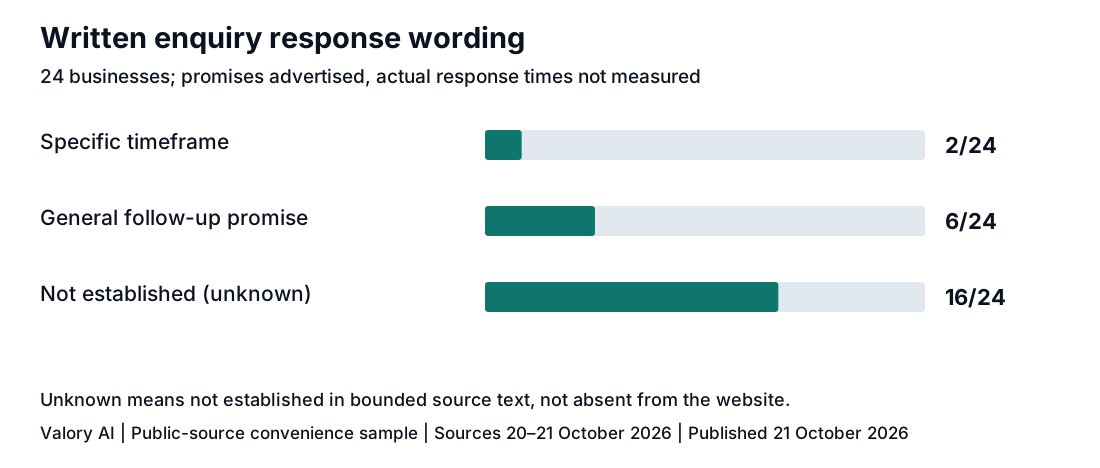
Sydney Metro Plumbing attached a two-hour response aim to email enquiries. CBD Dental Sydney attached one business day to its enquiry form. These are the two specific-time codes. The study did not send either business an enquiry and cannot establish compliance with those statements.
The general category includes wording about later staff contact or a fast reply without a defined deadline. Opening hours, emergency coverage, appointment duration and a visitor's preferred callback time were not treated as reply deadlines.
The remaining 16 should not be described as slow responders, inaccessible businesses or businesses with no promise. A timeframe might appear elsewhere, in a dynamic form or after submission. Those possibilities are outside this inspection.
What a business owner can take from this
Check whether each enquiry route tells the visitor what happens next. The useful distinction is whether the visitor has made a request, selected a time, or received confirmation.
For a written enquiry, make any promised next step clear and achievable: who responds, whether confirmation is still needed, and what the visitor should do if the matter is urgent. Keep any response-time promise tied to the actual staffed process. The study does not establish that a particular channel mix produces better results or that automation is the right remedy.
A short internal review can ask three questions:
- What does the visitor submit or select on this route?
- What still needs staff action before anything is confirmed?
- What response expectation and fallback does the visitor see?
These are practical review questions arising from the observed wording. They are not measured performance recommendations.
Method and source freshness
The research question, sampling order, eligibility rules, unknown treatment, coding definitions and request ceiling were frozen before discovery. The method's SHA-256 is 7a5ccda1433e36f244749394da9e12877391e1bb91ef6ac6076f31e3d97aea6d.
Discovery used 12 individual predefined searches. An initial four-query batch returned interleaved results without query attribution; it was discarded for selection, documented and repeated individually before businesses were selected. No replacement query was needed. The log retains every candidate encountered before each cell's second included business.
The final coding uses 25 readable primary-source page extractions for 24 businesses. Three additional opens covered two inaccessible candidates and one apparent duplicate brand. The primary text extraction tool may return cached content: its reported crawl ages range from today to five months before collection. “Accessed 20 October” is a retrieval date, not a claim that every page was freshly crawled that day.
A separate HTTP refresh attempted all 24 selected source URLs, with one redirect permitted per URL and no retry. Twenty completed successfully with HTTP 200 and exit code 0. Two returned 403, one exceeded the redirect limit and one timed out after returning partial HTTP 200 content. These accessibility results do not prove business-site faults. The cached primary extractions remain the coding source where live access was incomplete.
Accounting Connect illustrates the freshness limitation: cached text included a new-client restriction that did not recur in the fresh HTTP extraction. Its contact and meeting-request classification was supported in both versions; its current availability is unresolved. No restriction was used to remove a business from the sample after selection.
The original collection ledger records 72 known search/page attempts, including the discarded batch, failed access and reported redirects: 16 query requests, 28 text opens, one redirect disclosed by that tool, one failed direct-HTTP attempt, and 26 HTTP requests in the refresh including redirects. Search-engine internal fetches and unreported tool internals cannot be counted. Targeted independent review added 13 known public read attempts, bringing the original collection and review to 85 known attempts. Two supplementary public-source reads on 21 October bring the total to 87 known attempts, below the frozen 100-request ceiling. Review re-opened existing URLs and references; these can return refreshed text and are recorded separately. Maximum collection concurrency was two. We did not crawl sites exhaustively or bypass restrictions.
Before publication, an evidence-retention check found that two phone codes and one email code lacked sufficient retained original excerpts. Two explicitly dated supplementary source reads on 21 October established the advertised routes for those same businesses. These are new corroborating observations, not reconstructed 20 October captures. The sample, definitions and reported counts did not change; the source register separates the dates.
Limits
This is a small, search-based convenience sample. The query itself favours discoverable contact pages. Search ordering can vary by engine, time and context; equal metro/industry quotas do not make a representative sample. Website text and ownership can change. The retained order and excerpts make this run auditable, but do not guarantee that a fresh search reproduces the same businesses.
One analyst performed the initial coding. Targeted independent review corrected the CBD Dental Sydney booking classification using retained source evidence. The final evidence check also changed one general response promise to unknown because its connection to a written enquiry was not established; booking confirmation wording alone did not settle that separate question. No full second-coder agreement study was performed. Short text extractions can miss embedded forms, pop-ups, booking widgets, mobile-only controls and dynamic content. A label may overstate a process; an incomplete extraction may understate it. Unknowns are retained without imputation.
No customer/tenant dataset, recording, transcript or account was accessed. No enquiry, call, test booking or payment was made. No response time, call outcome, conversion, revenue, accessibility standard or legal compliance was measured. No significance test, confidence interval, causal inference or national estimate is warranted.
Why Valory AI produced this
Valory AI provides a managed AI receptionist service for Australian businesses and has a commercial interest in enquiry handling. It designed and funded this study. The selected businesses were not recruited as customers, did not endorse the study, and were not paid or contacted. The findings are not evidence of Valory AI product performance.
This public-source inspection is distinct from Valory AI's existing observed call-timing report. That published report describes a permissioned operational cohort; this study observes public website wording. Existing missed-call and call-handling benchmark pages contain modelled scenarios. No figures from those assets were combined with these observations.
Reproduction and corrections
Download the linked method, method hash, source register, per-field evidence cues, observations and calculation script into one folder. Run python3 analyse.py from that folder to regenerate counts and SVGs using the installed Python standard library. It checks the frozen method hash, 24 unique rows, two businesses per cell, source references and category totals. It makes no network requests. The CSVs and SVG text remain editable.
The source register contains public URLs, dates, short excerpts and tool line locators. The business-level CSV and per-field evidence file retain the specific cues supporting each positive code. Square-bracketed contact-value omissions are redactions, not words from the source. Business phone/email values and personal contact details are omitted. The HTTP receipt records fetch times, status and content hashes; it does not retain full pages.
Valory AI maintains this report and its source register. Targeted independent source/coding review is complete, with its correction incorporated. Read the source and coding notes. To propose a correction, contact Valory AI with the business ID, source ID and code in the CSV. A changed source is a new observation and should be dated separately from this snapshot.