Published: 15 October 2026
Quote Enquiry Form Template for Service Businesses
A copyable phone-enquiry worksheet for cleaning and service teams. Capture useful scope, show what is unknown and give the quoting team a clear next step.
By Valory AIThe Valory AI team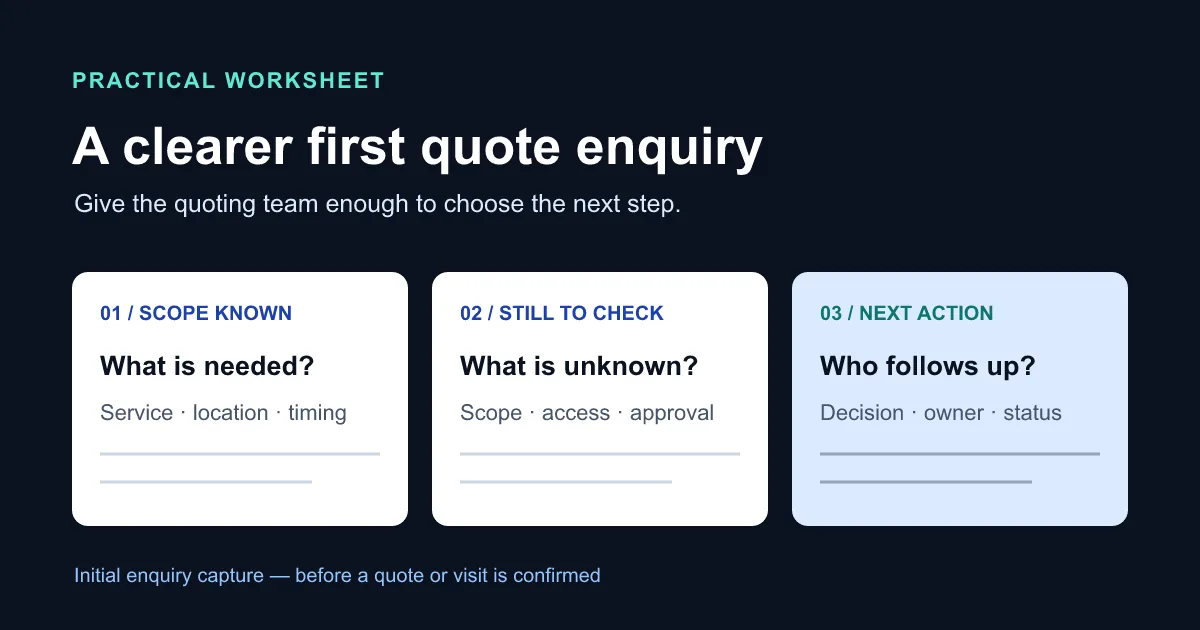
Use this template to capture an initial phone enquiry before preparing a quote. It is not a customer quotation document.
It suits staff, an answering service or an AI receptionist set up around your process. Record what the caller knows, what still needs checking and who will act next.
Copy the first-call worksheet
Use “not known” for an unanswered question. Label estimates as estimates and preferred dates as requests.
| Field | Question or record |
|---|---|
| New enquiry or existing work | “Is this a new job, or are you calling about work we already have underway?” |
| Service requested | Record the caller's description and confirm the relevant service if clear. |
| Location | Start with suburb or postcode to check the service area. Ask for a full address when the next step needs it. |
| Scope known so far | Property or site type, work requested and the few service-specific details your estimator uses. Mark approximate figures. |
| Requested timing | Preferred date or deadline. Record who supplied it; availability may still need checking. |
| Relevant constraints | For example, occupied premises, a preferred access window or required site assessment. Do not request passwords or entry codes in routine intake. |
| Contact and role | Details needed for the agreed follow-up, checked with the caller. Are they arranging the work or passing the request to someone else? |
| Missing information | List unanswered questions that affect the next decision. |
| Next action and owner | Scoping callback, estimator review, site-visit request or staff assessment. Name the responsible role and its backup. |
| What the caller was told | Request received, time awaiting confirmation, or an action actually completed. Record any agreed callback window. |
Blank form to copy
Copy this into your usual notes or intake document. Replace the placeholders and leave unanswered fields as “not known”.
New enquiry or existing work: [ ]
Service requested: [ ]
Suburb or postcode: [ ]
Site/property type and scope: [ ]
Approximate details, labelled as estimates: [ ]
Requested timing and who supplied it: [ ]
Relevant access or assessment constraints: [ ]
Contact name and role: [ ]
Checked callback details: [ ]
Missing information: [ ]
Next-step status: [ ]
Next action: [ ]
Owner and backup: [ ]
What the caller was told: [ ]
Agreed callback window, if any: [ ]
Confirmed appointment details, only if confirmed: [ ]
An enquiry can be useful with some empty fields. If the caller does not know the floor area, the estimator can decide whether to request a plan or assess the site. Asking the same question again will not make the answer more reliable.
Filled example: recurring office cleaning
This is a fictional example, not a customer record.
A business manager wants twice-weekly cleaning for a small office. They do not know the floor area, would prefer to start next month and say the landlord must approve contractor access.
Next decision: Quoting team to review whether a site assessment is needed.
Service: Recurring office cleaning, requested twice weekly.
Location: [Suburb supplied by caller].
Scope known: Office premises; caller wants common areas and amenities included. Exact rooms and floor area not confirmed.
Timing: Start next month preferred; no date agreed.
Constraint: Caller says landlord approval is needed for contractor access.
Contact: [Business contact and checked callback details].
Still needed: Confirm inclusions, access approval and assessment arrangements.
Owner: Quoting team; [agreed backup role] if unavailable.
Caller expectation: Request recorded for review. No price, start date or site visit confirmed.
The estimator can now choose the next question. The missing floor area and access requirement are visible, and the record does not imply that the business has accepted the job.
Choose a next-step status
Use labels your team understands. These are suggested planning labels, not software features.
| Status | Meaning | Next action |
|---|---|---|
| Needs scope clarification | A fact needed for the next decision is missing. | Assign a specific question to the person following up. |
| Ready for estimator review | The agreed intake facts are present; pricing or site assessment still needs judgement. | Send the known facts and uncertainties to the estimator. |
| Site visit requested | The caller wants a visit; it has not been confirmed. | Check the approved scheduling process and confirm separately. |
| Visit confirmed | The authorised booking process has succeeded. | Provide the actual confirmed details and approved preparation instructions. |
| Staff decision needed | The request is outside standard service, area or authority rules. | Refer it to the decision-maker without promising acceptance. |
“Ready for estimator review” means the team can assess the enquiry. A site inspection or fuller specification may still be needed before preparing a quote.
For the record sent after the call, use the enquiry handoff template. It brings the owner, completed action and remaining work together.
Adapt the questions to the work
Keep the common fields, then add only the questions the next person uses. A caller should not have to complete questions intended for another service.
Recurring commercial cleaning
Ask about site type, approximate size if known, cleaning frequency, preferred cleaning window and proposed start period. Establish whether one site or several need assessment.
Leave final inclusions, site condition and pricing with the quoting team. The cleaning call-handling guide covers commercial, bond and existing-customer calls in more detail.
Property maintenance or garden work
Establish the requested work, location and approximate extent if known. Follow your own rules for when a site assessment is needed. Separate a new project from a query about work already scheduled.
If the caller is a property manager, ask whether they can approve the next step or need an owner's decision. Their job title alone does not establish spending authority.
Trades and repairs
Capture the caller's description, relevant service, location and requested timing. Staff decide the diagnosis, scope, price and attendance arrangements.
This worksheet is for routine quote intake. If a caller describes a situation covered by your urgent-call policy, follow that approved pathway. The tradie call-handling guide covers the wider intake and escalation workflow.
Set the rules and close the call clearly
Before using the sheet, agree which services and areas you cover, who can approve prices or appointments, and who receives enquiries when the usual estimator is away. Keep these rules beside the worksheet.
Once the request has actually been recorded, a closing explanation could be:
“I've recorded the work you're asking about and the information the team still needs. They'll review the request before confirming the quote process.”
State a callback window only if your team has agreed to it. Otherwise, record the caller's preferred time as a preference.
If a booking attempt returns an uncertain result, have the responsible person check it before trying again. The record should show that the visit is awaiting confirmation.
For the separate step of preparing the written quote, business.gov.au's quoting guidance covers understanding the customer's goals and defining the work included.
Check whether the sheet helps
Try it with fictional enquiries and ask the people who receive the records:
- Which answer changed the next decision?
- What useful detail was still missing?
- Which question could we remove for this service?
- Was the difference between a request and a confirmed appointment clear?
- Was someone responsible when the usual estimator was away?
Use your approved records and privacy process. Collect the information needed for the next step, rather than filling every field for its own sake.
If you measure results, keep useful intake, follow-up, quotes issued and paid work separate. Compare similar enquiry types and leave unknown outcomes unknown.
Put the worksheet into your call-handling process
Once the questions, owners and exceptions are clear, decide who should handle the first call. Existing staff may be the right choice. An answering service or an AI receptionist set up around your process can cover agreed intake when staff are occupied or unavailable.
Valory AI's CleanMade case study describes service and quote-context capture followed by structured handoffs into the cleaning team's triage process. See call handling for cleaning businesses for the service context.
Bring three typical enquiry types and a blank version of your current intake sheet to a walkthrough. We can work through the useful questions, handoff and limits before discussing how to set it up.