Published: 16 October 2026
Can an AI receptionist handle multiple calls at once?
AI receptionists can handle simultaneous calls within configured limits. Learn how capacity, monthly minutes, queues and transfers affect busy periods.
 By Matthew WalkerFounder, Valory AI
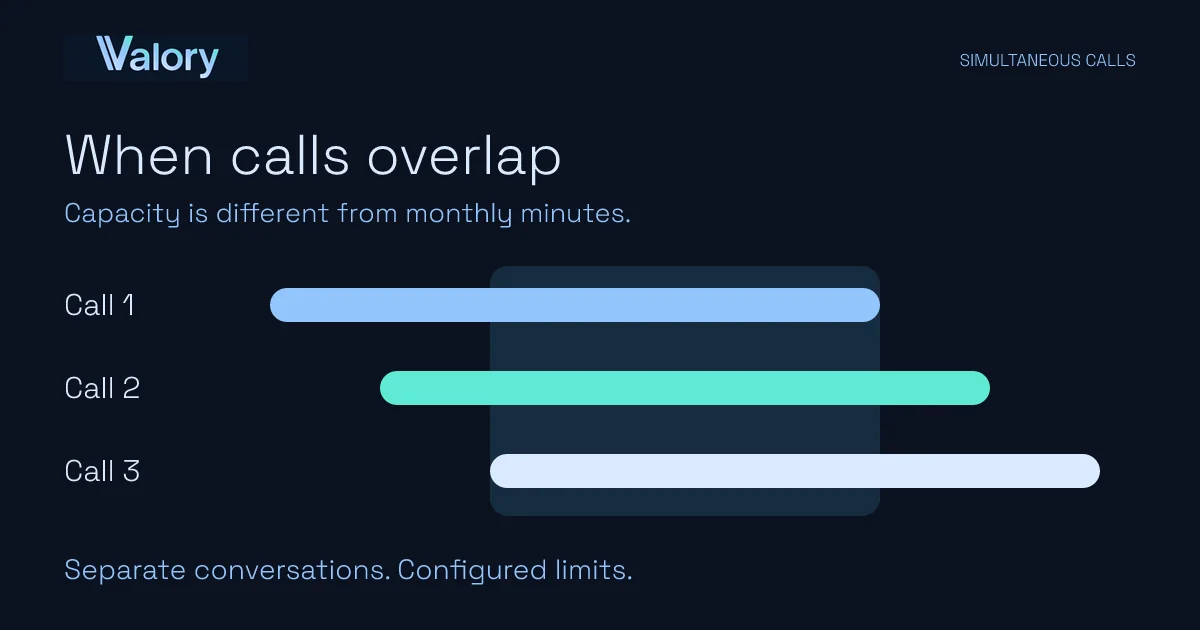
Yes, an AI receptionist can handle more than one call at a time when the service and phone setup support it. Each caller has a separate conversation. The useful limit is how many conversations your proposed service can handle simultaneously, and what happens to the next caller when that capacity is used.
That is different from the number of calls or minutes included in a monthly plan. A business can use very few minutes overall and still have several people call at the same time.
Before choosing a service for busy periods, establish three things: how many calls can reach it, how many it can answer together, and what callers experience beyond that limit.
Monthly minutes do not tell you how many calls can overlap
Providers often use the term concurrency for the number of conversations happening at once. It is a measure of overlap, rather than total workload.
Consider a fictional business receiving three calls, each lasting four minutes:
| Arrival pattern | Total conversation time | Highest number of overlapping conversations |
|---|---|---|
| Calls start at 9:00, 9:05 and 9:10 | 12 minutes | One |
| Calls start at 9:00, 9:01 and 9:02 | 12 minutes | Three |
The second pattern needs more simultaneous capacity even though the total conversation time is the same. These figures describe the example, not a provider's billing calculation; rounding, waiting time and transferred call segments may be treated differently in a particular plan.
Call length matters too. If one caller needs a longer conversation, that call continues to occupy capacity while new calls arrive. With room for several conversations, other callers can still be answered up to the remaining limit. Once every available place is occupied, the next call needs a different outcome.
This is why an average number of calls per day is a poor substitute for understanding a busy half-hour.
Check the complete call route
The receptionist is one part of the route between your customer and your team. A capacity claim needs to apply to the setup you will actually use.
Start with the published business number. If calls pass through an existing phone system or forwarding service, ask whether that route can deliver the intended number of simultaneous calls. A demonstration on a provider's own number does not establish the behaviour of your current route.
Next, check the receptionist's capacity. ElevenLabs' concurrency guidance, for example, ties simultaneous conversations to the subscription. A provider's underlying technology supporting parallel calls does not tell you the allowance allocated to your business.
Ask whether the quoted limit is reserved for your service or shared across numbers, locations or other agents. If two branches share a pool, a peak at one branch may affect how much remains for the other. Have the provider explain the actual arrangement rather than assuming each number has its own allowance.
Also clarify what each technical limit measures. “Calls per second” describes how quickly calls start; it is not the same as how many remain active. For example, Twilio's Call resource documentation applies its calls-per-second limit to calls started through that API, and explicitly distinguishes inbound calls. Ask for the limit relevant to incoming customer calls, rather than comparing unrelated headline numbers.
You do not need to become a telephony engineer. You need one clear answer about the usable capacity of the complete route and any shared limits that could affect it.
What happens when the receptionist is full?
Agree what the next caller will hear before you rely on the service. Possible arrangements include waiting, an alternative answering destination or a message-taking route. Some setups reject a call at their limit. The available choices depend on the phone system and receptionist configuration.
For a concrete platform example, ElevenLabs documents call queueing that can hold callers until an agent has capacity. Its documentation also describes a maximum wait followed by disconnection. Queueing is therefore a specific behaviour to check; AI reception does not inherently mean nobody waits.
A waiting caller has not yet had their enquiry handled. Ask how waiting and abandoned calls are reported, what the caller hears and whether the agreed alternative is available if they cannot wait. If the message offers a callback, confirm how that request is actually captured; hold music alone does not collect one.
Some platforms offer extra capacity for short peaks. ElevenLabs, for example, describes an optional burst-capacity feature with different charging and processing priority. That is an example of a configurable option, not a Valory AI inclusion or a universal promise. Ask whether any equivalent is included in your proposal, its limit and how the cost changes.
Compare ordinary demand and the busy period you want covered. The cheapest headline allowance is not necessarily the right choice if its overflow behaviour does not suit your callers. Our receptionist cost comparison helps assess the wider service and staffing costs.
More answering capacity does not create more staff or appointment slots
Several callers can be speaking with a receptionist service while your team still has only one person available to receive a transfer. The answering side and the staff side need compatible expectations.
For a fictional service office, two callers might both ask for the same specialist while a third asks about opening hours. The third enquiry may be answerable from approved information. The two specialist requests depend on that person's availability and the agreed alternative. Handling all three initial conversations does not mean all three requests can be completed immediately.
Bookings have a similar distinction. Two conversations can ask for the same remaining appointment. If direct booking is part of the proposed service, the booking process needs to resolve availability correctly and confirm only what has actually been secured. More simultaneous conversations do not create extra appointments.
Discuss these situations alongside the call limit. Otherwise, you may move the waiting point from the phone greeting to a busy employee or an appointment that cannot be confirmed.
The peak-period phone guide covers how to choose what staff answer, what can be handled routinely and what needs a different next step.
Work out the capacity your business needs
Use call records you are authorised to review to look for overlap during representative busy periods. Start and end times are more useful for this question than a daily total alone. Separate the time a caller waited from the time they spent in a conversation where the records allow it.
Look at ordinary busy periods and known exceptions separately. A service business's Monday opening, a gym's class-enquiry period and a venue's calls before evening service may produce different patterns. These are situations to examine in your own records, not assumptions about every business in those industries.
Missed or rejected calls matter because they may never appear in the receptionist's completed-conversation report. Compare the phone-system view with the answering-service view before concluding that the recorded conversations represent all incoming demand.
Then decide what level of waiting or overflow is acceptable for each common request. You may need immediate answers for a narrow set of simple questions while accepting a clear callback process for work requiring staff judgement. That choice affects which capacity is useful to buy.
Allow for foreseeable changes such as another location using the same service or a campaign that invites calls. Avoid treating an unexplained maximum from one unusual day as a permanent requirement. Review what caused the peak and whether the proposed fallback would have been suitable.
Ask for a demonstration of overlap
A good one-caller demonstration shows the conversation. It does not show what happens while that conversation is already underway.
Arrange a small, controlled demonstration with the provider using fictional callers and agreed test destinations. Keep one conversation active while another starts. Include the route you intend to use, then have the provider safely demonstrate the agreed capacity-limit behaviour. Do not create an unplanned load test on a live business number.
Check that each caller gets a separate, coherent conversation and that their details stay with the correct enquiry. Listen to what the additional caller hears, including any waiting or alternative route. If transfers or bookings are included, inspect a representative result while calls overlap.
The provider should explain which parts the demonstration establishes and which remain untested. A test with two calls does not prove an advertised limit of twenty, or how every connected system behaves at that limit. The AI receptionist vendor checklist can help record the demonstrated scope and material gaps.
After launch, distinguish calls answered promptly, calls that waited, abandoned calls and requests that reached a useful result. Review peak periods as well as monthly totals. More answered calls can be valuable, but answered-call volume alone does not establish better service or more business.
Match the service to the busiest part of your day
Bring the call pattern you want to cover, your current phone arrangement and the requests your team still needs to handle. That gives a provider something concrete to assess beyond “Can it take lots of calls?”
Valory AI is a managed AI receptionist service for Australian businesses. Book a walkthrough to discuss the proposed capacity, call handling and overflow behaviour for your business.