Published: 16 October 2026
Can an AI receptionist give prices and quotes over the phone?
Learn when an AI receptionist can share approved prices, explain an estimate or capture a quote request, and what to check before using it for pricing calls.
 By Matthew WalkerFounder, Valory AI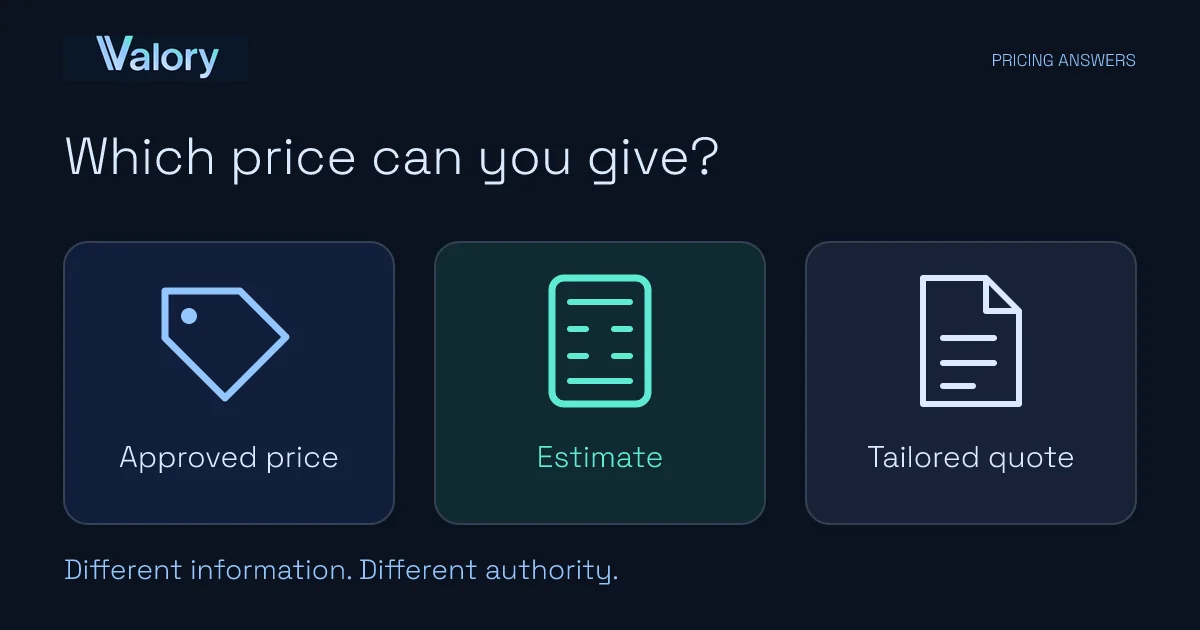
Yes, an AI receptionist can be configured to share prices your business has approved. Whether it should give a final figure depends on what that figure covers and what the caller is asking for.
A published price for a standard service is a different task from estimating an unknown repair or preparing a commercial cleaning quote. Start by deciding which answers are fixed, which need clarification and which require someone to assess the work. Then ask the provider to demonstrate those boundaries using your proposed setup.
You can give callers useful pricing information without promising that every job can be quoted during the first call.
Separate a price, an estimate and a tailored quote
The word “quote” can hide several different expectations. A caller may only want to know the price of a standard appointment. Another may expect an agreed amount for a job whose scope is still unclear.
| What the caller needs | What an AI receptionist could do within an agreed scope | What needs to be settled first |
|---|---|---|
| A fixed price for a defined service | State the approved price and explain what it includes. | The correct service, current price and any conditions that affect the total. |
| An indicative range | Repeat an approved range and explain what still needs checking. | The circumstances where that range applies and clear wording that it is an estimate. |
| A tailored quote | Collect the facts needed for assessment, or use a specifically configured quoting process. | Required information, pricing rules, approval authority and the process for issuing the quote. |
Avoid giving the receptionist a list of numbers without the explanation that makes them useful. An hourly rate needs a description of what is billed by the hour. A visit fee needs to say whether it covers assessment, work or both. A starting price needs to explain which version of the service it describes.
If the business has not approved a range, the receptionist should not invent one to satisfy a caller who asks for “just a ballpark”. It can explain the price-setting process and help the caller take the next step.
What a useful pricing answer sounds like
These examples are fictional. The amounts illustrate the conversation, not typical industry prices or a Valory AI customer setup.
A standard service with a fixed price
Suppose a salon has approved a total price of $85 for a particular cut-and-finish appointment, with colour services priced separately.
“The cut and finish is $85. Colour services are separate. Are you asking about the cut and finish, or would you also like to discuss colour?”
The answer names the service before treating the price as relevant. If the caller changes the request, the receptionist needs to check the new scope instead of carrying the first figure forward.
An assessment fee before the work can be priced
Suppose an appliance repair business has approved a $120 assessment visit for a defined service area. Repairs are quoted after inspection.
“The assessment visit is $120 for your area. That covers the inspection, not the repair. The technician will explain the repair cost after checking the appliance.”
That gives the caller a useful known cost without pretending the fault has been diagnosed. Whether the assessment fee is later credited towards a repair is a separate business rule; the receptionist should only say so if it is approved.
A job that needs a tailored quote
A business asking for recurring office cleaning may describe the floor area but leave out frequency, access restrictions or required inclusions. A receptionist should not turn that incomplete description into a firm price.
It can ask enough to establish the request and explain whether the next step is a callback or site assessment. Our commercial cleaning call-handling guide explores those differences in more detail.
The same principle applies to any service where the cost depends on work that has not yet been defined.
Where does the receptionist get the price?
Ask the provider to show the source behind the spoken answer. Two common arrangements serve different needs.
An approved price document can hold a service menu, standard fees and permitted answers. For example, ElevenLabs documents how an agent can use business documents, including product and pricing information, as a knowledge base. A document still needs an owner who keeps it current.
A connected lookup can retrieve information from another system during the conversation. ElevenLabs' webhook tools documentation describes connections to external systems for current information. This is a platform capability that requires configuration. It does not establish that a particular receptionist service includes a connection to your price list, booking system or quoting software.
Ask the provider to distinguish four things: reading a price, calculating an estimate, preparing a quote and issuing it to the customer. Support for one does not establish support for all four.
For a connected workflow, inspect which inputs it uses and what comes back. If the caller changes the quantity or adds another service, the original result may no longer apply. If the lookup fails, the receptionist needs an agreed response that explains the uncertainty and offers a useful next step.
Make the full answer clear on the phone
A customer cannot see the conditions beside a price when it is spoken. Keep the answer short, but include the detail that would change their decision.
For each approved price, settle the service or unit it covers, the inclusions, relevant extra charges and any eligibility conditions. A weekly service price should not sound like a one-off total. A promotional price should not be offered to someone who does not qualify.
The ACCC's pricing guidance covers verbal price communication and says businesses must give consumers clear, accurate prices without creating a misleading impression. Its guidance also addresses total prices and unavoidable fees. Apply that principle to the spoken answer: explain what the caller would actually be paying for, including relevant charges, before they decide to proceed.
When an extra cost cannot yet be worked out, explain what information is missing. A vague “terms apply” at the end of a number is less useful than saying what still needs assessment.
For example, if travel charges depend on location, establish the service area before presenting a visit fee as the caller's total. If a requested extra changes the price, explain that change before treating the original figure as agreed.
Keep tailored quotes tied to a defined scope
For more complex work, the receptionist can make the eventual quote easier to prepare by collecting relevant facts. It should preserve the difference between what the caller confirmed, what they estimated and what remains unknown.
Our quote enquiry intake template helps capture those details. Use it for the initial enquiry; the customer quotation is a separate step.
Business.gov.au's quoting guidance recommends a written quote that clearly describes the work, costs and terms. That is a useful standard when evaluating an automated quoting proposal: a spoken number alone does not show that the customer has received the scope and conditions they need.
If a provider proposes generating quotes during calls, ask who approves the calculation, which variations it can handle and how the customer receives the result. Demonstrate a changed request and an incomplete request as well as the straightforward case. Keep negotiation, discounts and exceptions with the person authorised to decide them unless specific rules have been agreed and tested.
Plan for price changes and conflicting information
A correct answer today can become wrong when a menu changes or an offer expires. Name the person who approves prices and the person who updates the phone service. Agree when a change takes effect and how to check the spoken answer afterwards.
Remove or retire superseded information so the receptionist is not choosing between an old brochure and a new price list. For a promotion, include its end date and what callers should hear after it ends.
A caller may mention an old advertised price or a special arrangement with a staff member. The receptionist should record the discrepancy for review rather than confirm an unverified discount. The business needs to resolve which price or agreement applies.
If the current source is unavailable, decide whether the service should use a specifically approved fallback answer or stop short of giving a price. Do not leave that decision to an improvised answer during the call.
Test the questions that could change the price
Before relying on pricing answers, arrange a demonstration using fictional callers and your approved information. Include a standard service, a request with a relevant extra, a change of scope halfway through the call, an expired offer and a request outside the price list. If a system lookup is included, also ask the provider to demonstrate an unavailable result safely.
Listen for more than whether the first number is correct. Does the receptionist choose the right service, explain the important conditions and revise its answer when the caller corrects a detail? Does it keep an estimate separate from an agreed price? If it cannot answer, does it explain what happens next?
For any written quote or follow-up included in the proposed scope, check the actual test result. The spoken answer, issued document and record staff receive should agree. Our AI receptionist vendor checklist covers the broader evidence to request before choosing a provider.
After launch, review authorised records for wrong figures, omitted conditions and promises outside the agreed scope. Fix the information or workflow behind the error. Keep accurate pricing answers, quote requests and paid work as separate outcomes when assessing whether the service helps.
Start with the pricing questions you can answer clearly
Bring your current approved prices, the questions callers ask and a few examples that still need staff judgement. That makes it easier to agree a useful initial scope and identify what needs further checking.
Valory AI is a managed AI receptionist service for Australian businesses. Book a walkthrough to discuss which pricing questions could fit your proposed phone workflow and which should remain with your team.