Published: 10 June 2026 · Last updated: 21 October 2026
Best answering service for property management companies in Australia
Compare AI, human, and hybrid answering services for property managers handling maintenance, leasing enquiries, landlord calls, trades, and after-hours emergencies.
 By Matthew WalkerFounder, Valory AI
The best answering service for a property management company is not the one that simply "takes messages". Property management calls create operational work: maintenance triage, leasing speed, owner trust, tenant frustration, and after-hours emergencies.
If a caller reports flooding, gas smell, a lock-out, or no hot water, a generic message is not enough. If a prospective tenant asks about an inspection, speed affects leasing outcomes. If an owner calls about a vacancy or repair cost, tone and routing affect retention.
This guide compares the answering-service options available to Australian property management agencies and explains where AI, human reception, and hybrid models fit.
TL;DR
- Property management answering needs triage, not message taking.
- Human answering services are stronger for emotional or unusual calls.
- AI receptionists are stronger for structured maintenance capture, leasing enquiry capture, FAQs, and after-hours volume.
- Hybrid models work well: AI for repeatable intake, humans for judgement, complaints, or urgent exceptions.
- The right provider is the one that can separate tenants, landlords, trades, and prospective tenants without leaking information between groups.
What property management calls require
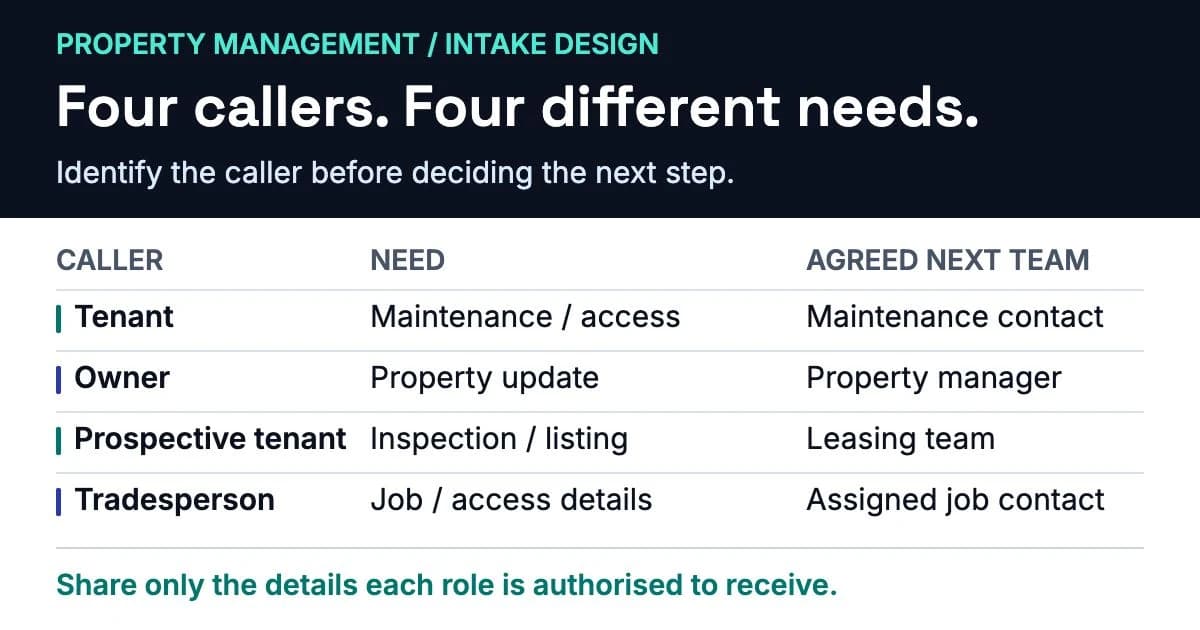
Property management has four caller groups that must not be mixed:
| Caller | What they usually need | Risk if handled poorly |
|---|---|---|
| Tenant | Maintenance, access, lease questions, urgent repairs | Slow response, escalation failure, privacy mistakes |
| Landlord / owner | Property manager callback, update, financial or repair question | Trust loss, wrong disclosure, retention risk |
| Prospective tenant | Listing availability, inspection booking, application process | Lost applicant |
| Tradesperson | Access, job status, invoice or scheduling issue | Delayed repairs |
An answering service that treats all four as "name, number, message" will create work for the agency. A useful service captures the next-action fields.
AI vs human answering for property management
| Scenario | AI receptionist fit | Human answering fit |
|---|---|---|
| Routine maintenance | Strong | Good |
| Emergency maintenance triage | Strong if escalation is tested | Strong if trained and available |
| Leasing enquiry capture | Strong | Good |
| Owner complaint | Escalate only | Strong |
| Tenancy-law question | Capture and route | Capture and route |
| After-hours volume | Strong | Can become expensive |
| Highly emotional caller | Escalate | Strong |
The best model is usually layered. AI answers quickly, captures structured details, and escalates high-risk calls. Humans handle judgement, complaints, and exceptions.
What a good property management answering service captures
Maintenance request
Capture:
- tenant name
- property address
- issue description
- how long it has been happening
- whether anyone is at risk
- access notes
- photos or photo-upload link where available
- preferred contact time
Do not authorise repairs or promise a tradesperson. Route the request based on urgency.
Emergency maintenance
Agree escalation triggers that reflect the tenancy rules applying to the property, then configure the agency's contact sequence and fallback. Examples to cover include:
- flooding or burst pipe
- fire or smoke
- gas smell
- electrical hazard
- lock-out where safety is involved
- loss of hot water or another essential service, assessed under the applicable tenancy rules
- security breach or break-in
Urgent repairs and immediate danger are different. Agency preference alone does not determine the legal classification: for example, Queensland RTA guidance includes failure of essential hot-water services and specifies the accommodation types its emergency-repair rules cover. Check the rules for the property's jurisdiction and tenancy type during setup.
Use approved emergency wording and direct immediate danger to emergency services before intake. Confirm only what has happened: a recorded request, a sent alert or an accepted callback. Follow the agreed fallback if the recipient is unavailable; do not present an alert as a repair arranged or promise contractor attendance.
Leasing enquiry
Capture:
- listing address
- caller name
- phone and email
- desired move-in timing
- number of occupants
- pets if volunteered
- inspection preference
- specific question for the property manager
The goal is speed and structure. A prospective tenant should not wait until the next morning just to find out how to inspect a property.
Landlord / owner call
Capture:
- owner name
- property address
- requested property manager
- broad reason for call
- urgency
- best callback window
Do not discuss tenant details, arrears, repair costs, or financial information unless a human property manager has authorised the exact process.
Provider patterns to compare
Australian property managers will usually encounter:
- traditional virtual receptionist providers such as OfficeHQ, ReceptionHQ, Ruby-style answering services, or similar
- broader answering-service marketplaces
- property or real-estate focused call-handling providers
- AI receptionist providers such as Valory
- DIY phone AI tools
Selection checklist
Before choosing a provider, ask:
- Can you identify caller type before collecting sensitive details?
- Can tenant, landlord, and trades calls follow different scripts?
- What exactly triggers emergency maintenance escalation?
- Who receives urgent calls after hours?
- How are leasing enquiries captured and routed?
- Can the service create structured maintenance summaries?
- Can it integrate with PropertyMe, Console Cloud, MRI, Rex, or at least send structured email?
- Can it avoid legal advice on tenancy matters?
- Can it handle repeat callers without exposing private information?
- Can we review call outcomes weekly after launch?
Practical recommendation
Use a human answering service if your main problem is emotional caller handling or complex owner complaints.
Use an AI receptionist if your main problem is high-volume, repeatable calls: maintenance, leasing, FAQs, after-hours capture, and structured handoffs.
Use a hybrid model if you want the speed and consistency of AI with human escalation for complaints, sensitive owner calls, and unusual emergencies.
Valory is strongest when the agency wants the call flow designed and managed, not merely a phone answered.
FAQ
What is the best answering service for property management?
The best option is the one that can separate maintenance, leasing, owner, tenant, and trades calls with clear escalation rules. Generic message taking is rarely enough for property management.
Can an AI receptionist handle after-hours emergency maintenance?
Yes, if the triggers reflect the applicable tenancy rules and the agency's escalation paths are approved and tested. Direct immediate danger to emergency services, then capture the report and alert the agreed contact. A sent alert is not an accepted callback or an arranged repair. Use the approved fallback when the recipient is unavailable; do not authorise repairs or promise attendance.
Should property managers use AI or human receptionists?
Many agencies should use both. AI handles volume and structure; humans handle judgement, complaints, and relationship-sensitive calls.
Can Valory connect to property management software?
Integration depends on the software and permissions available. Where direct integration is not the right first step, Valory can still send structured handoffs that are more useful than voicemail.