Published: 15 October 2026
When business calls take over your personal mobile
Separate work and personal calls without losing the number customers know. Compare number choices, dual SIM, callbacks and cover when you cannot answer.
 By Matthew WalkerFounder, Valory AI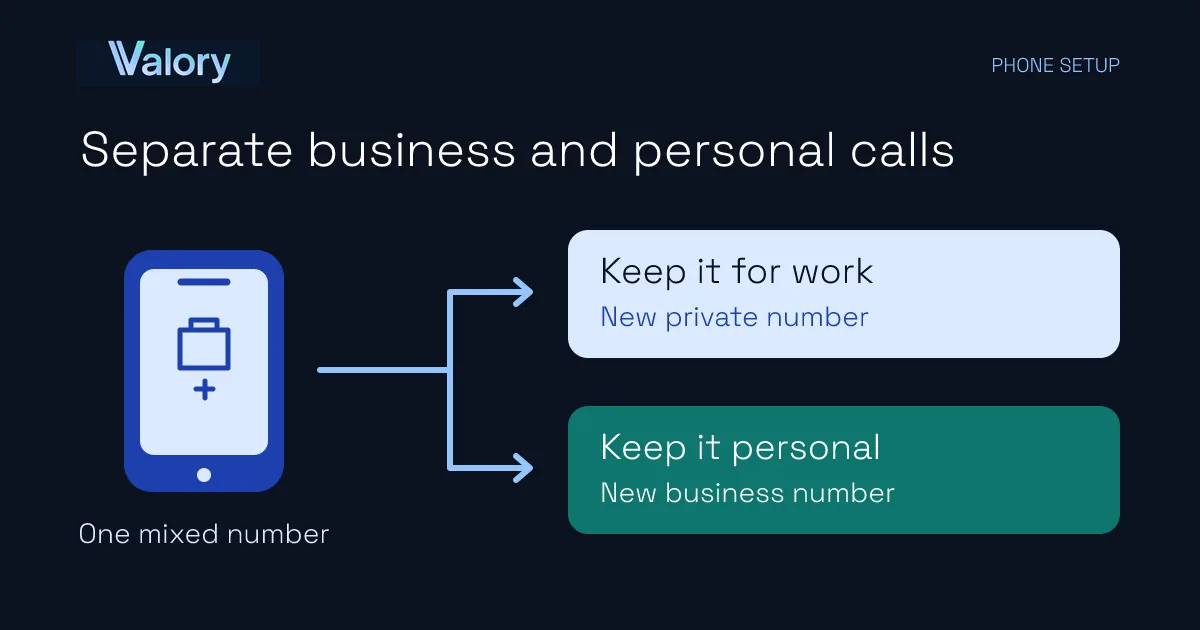
Your mobile number is on the website, the ute or the invoices. Customers have saved it. It is also the number your family calls, so putting the whole phone on silent is an awkward way to finish work.
You can create more separation without asking every customer to find you again. The first decision is which role your existing number should have: keep it as the business number and move personal contacts to a new one, or keep it private and introduce a new business number.
Then decide what business callers should hear when you are unavailable. A second number gives you a boundary; someone still needs to answer, take a message or return the call.
Decide who keeps the number customers already know
There are two reasonable ways forward. The better fit depends on how widely the current number is used and which group would be easier to move.
Keep the existing number for the business
This is worth considering when the number is established: it is printed on signage, appears in directories and sits in years of customer contact lists. Customers keep dialling it while you introduce a new number for personal use.
The work is on the private side. Family and friends need the new number. You also need to review services that use the old number for personal contact, account recovery or verification. Keep access to those services while you make the changes.
The existing line can stay on its current mobile service while you assess the answering arrangements. Making a number business-only does not, by itself, require moving it to a new provider.
This choice will not make every personal caller disappear from the old number immediately. Give people time to update their contacts before sending all calls there to a business answering service.
Keep the existing number personal and add a business number
This can be simpler when relatively few customers have the number, or when changing your private contact details would be the larger job.
Publish the new business number on your website, business listings, quotes and invoices. Tell current customers where to contact the business when you next deal with them. Use the business number for subsequent calls and messages so they have a reason to save it.
The limitation is the transition: customers who have your old number can still call it. A new number on the website does not update their phones. You will need to redirect those conversations consistently rather than continuing to handle every request through the private line.
A simple message is enough: “We now use [business number] for work enquiries. Please save that number for future calls and texts.” Only include texts if someone will actually receive and respond to them there.
If a provider change is part of either option, confirm the number-retention arrangements, possible interruption and costs before proceeding. ACMA's switching guidance explains the checks to make with your telco.
You may be able to keep one handset
Two phone numbers do not necessarily mean carrying two phones. Telstra's dual-SIM guidance explains how compatible devices can use separate mobile services, each with its own number and plan. The supported SIM and eSIM combinations depend on the device.
Choose the arrangement around how you want to work:
| Arrangement | Useful when | What still needs attention |
|---|---|---|
| Two mobile numbers on one compatible phone | You want separate work and personal numbers with one handset. | Both lines are still in your pocket. Check outgoing-line selection, voicemail and what happens when one line is already in use. |
| A separate work phone | Physically putting work away is valuable to you. | Leaving the phone behind needs a deliberate answer or callback arrangement. There is another device and service to maintain. |
| A business calling service used through an app | You want to assess features such as shared answering or business-hours routing. | Confirm the actual calling, messaging, caller-ID and connectivity behaviour with that provider. Features differ. |
A second SIM is a reasonable option if the main issue is mixing numbers. If the main issue is answering calls during appointments or jobs, it still leaves you with that task.
Forwarding a mixed number also affects personal callers
Before diverting an existing mobile to an answering service, consider who still calls it.
Ordinary all-calls forwarding sends incoming calls on that number to the nominated destination. It does not know which caller is a customer and which is a relative. Conditional forwarding changes when the call is diverted, such as when it goes unanswered or the line is busy. Telstra's mobile forwarding guide describes those different conditions.
That makes forwarding easier to reason about once the number has a clear business role. You can decide whether to answer first, use cover while you are working, or have another service answer the business line.
Use the Australian call-forwarding guide for the carrier steps after you have chosen the intended route. Check your exact service's support and charges; do not assume a setting documented for another carrier or phone system applies.
Also treat texts as a separate part of the change. Before promising customers that a new arrangement handles their messages, send a test SMS and check where it arrives and who can reply. A successful forwarded phone call does not demonstrate the message path.
Make it possible to be unavailable
The practical boundary is a clear answer to “What happens if I cannot take this call?”
For a business with a small number of routine enquiries, a clear voicemail greeting and a callback period you can keep may be enough. A colleague or answering service may be more useful when a caller needs a conversation, or when you cannot reliably return messages during the day.
For example, imagine a solo consultant who is unavailable during client appointments. New enquiries could leave their purpose and preferred callback details, while a specific change to today's appointment goes to a route the consultant has agreed to monitor. That is an illustrative arrangement, not a customer case study. Its value depends on the owner actually honouring the callback commitment.
Avoid making every request for the owner trigger an immediate transfer. Decide which situations justify an interruption and what happens if that transfer is unanswered. Otherwise, the new business number can become another route to the same constantly ringing mobile.
If you are deciding whether forwarding alone will cover the need, our guide to forwarding and call handling explains the difference.
Keep the boundary when you call back
Receiving calls on a business number is only half the arrangement. Returning a customer call from your private line can give them that number again.
Check the outgoing number before calling or texting customers. On supported iPhones with Dual SIM, you can label the lines, choose a default and assign a line to a contact. Apple also explains that the phone can remember the line last used for that contact. The details are in its Australian Dual SIM guide.
If you use a business calling app, ask the provider how outbound calls display your business number, then check it by calling a phone you control. Include message replies in the same check. Do not rely on the app name or a setting label as proof of what the recipient sees.
Keep your personal number out of routine business email signatures and message templates if you want customers to use the business route. Giving it out as a shortcut each time you return a call makes the separation harder to maintain.
Make the change in a manageable order
Set up and test the intended business route before changing public contact details. Confirm who answers, what callers hear when nobody is available, and where messages go.
Then update the places you control, starting with the website, business listings, quotes and invoices. Let active customers know as part of normal dealings. Keep monitoring the old route during the transition so you can identify customers who still use it and direct them to the right place.
Test both numbers from another phone. Include a business call while you are unavailable, a personal call, a returned customer call and a text message. If a second SIM is involved, test an incoming call while the other line is in use as well. Device and carrier settings can affect that behaviour.
The useful result is specific: customers have a reliable business contact, personal callers can still reach you, and you know when work is allowed to interrupt.
Where a managed receptionist fits
Once you have decided which number is for business, you can choose how much call handling to delegate.
Valory AI is a managed AI receptionist service for Australian businesses. We configure phone workflows to answer agreed questions, capture enquiries, book appointments where configured and escalate to staff. Whether your existing number can feed that workflow depends on your phone provider and service, and the proposed route needs testing.
If you already know the cover you want, the AI receptionist setup guide explains what comes next. If you want help working through it, book a walkthrough and bring your current phone arrangement and the calls you want to stop interrupting your day.