Published: 16 October 2026
Business phone disruption: what to tell callers and do next
Keep callers informed during an unexpected closure or phone outage. Check diversion limits, explain what still works and follow enquiries through recovery.
 By Matthew WalkerFounder, Valory AI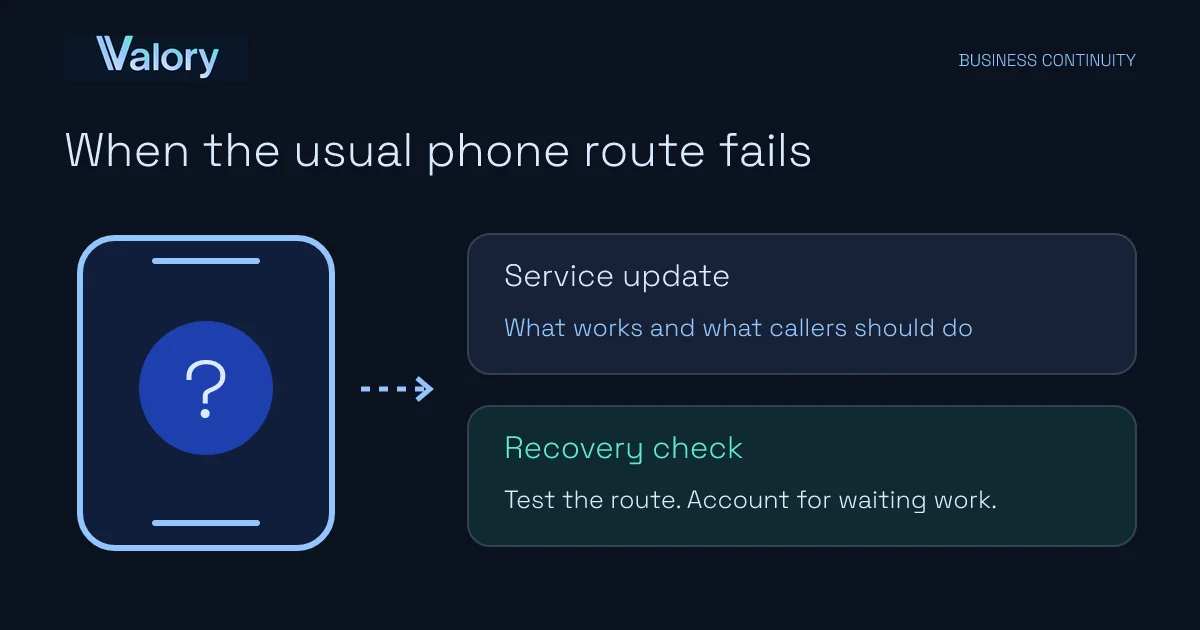
When your phones, internet or premises become unexpectedly unavailable, callers need three things: an accurate explanation, a working next step where one is available, and a clear way to get the next update.
Once immediate safety needs are handled, start by checking what still works. Then put one person in charge of the temporary customer message and the enquiries that need follow-up. You can explain the current situation without guessing when normal service will return.
An unexpected closure is different from annual leave. The reopening time may be unknown, the team may be unable to access bookings, or the phone may be working while the business cannot deliver its usual service. Your response needs to reflect that specific situation.
First, establish what is actually unavailable
Separate the ability to receive a call from the ability to do something useful with it.
A power cut at the office might stop desk phones and computers. A carrier fault might prevent calls reaching the business number at all. A booking-system problem might leave the phones working but prevent the team from confirming appointments. Premises could be closed while staff can still answer remotely.
Check the published number from another working phone, where possible. Confirm which destination answers, what the caller hears and whether staff can see any resulting message. Check your provider's current service information and report the fault through its support process. An apparently normal internet connection does not establish that the phone route is working.
Then decide what the team can currently offer. It may be normal reception, information and message-taking only, or a notice directing customers to another monitored contact route. Do not leave an old greeting promising bookings or same-day service if those actions are unavailable.
Understand what diversion and backup can cover
A mobile diversion depends on the route still working
Forwarding can help when calls can reach your provider but the usual destination cannot answer. For example, Telstra's mobile forwarding guidance describes an unreachable diversion for a phone that is switched off or outside coverage, as well as other forwarding conditions.
That feature is not evidence that calls will survive every failure in the network carrying the number. The destination also needs to be reachable and able to answer.
Ask your provider which fallback is supported for your exact service, where it is configured and how an authorised person can change it if the office equipment is offline. Have that method agreed before you need it. A handset procedure that requires a working connection may be unusable during the fault you are trying to address.
Our Australian call-forwarding guide covers the carrier-specific setup once the intended route is clear. After a change, test the published number as well as the destination; calling the destination alone does not prove that customers can reach it through the usual number.
Cloud answering and office connectivity are separate dependencies
A remotely hosted answering service may remain reachable during an office internet failure if the incoming number and the rest of the route still work. But transferring the caller to an offline desk phone will not restore the conversation. Staff may also be unable to access messages or booking systems.
The word “cloud” is not a continuity guarantee. Telstra's Cloud Calling for Business information, for example, warns that a power failure may prevent use of that service for calls. Check the dependencies and limits of the service you actually use.
During an interruption, a working answer may therefore need a smaller scope: explain the current situation and record a request that staff can access, without attempting unavailable transfers or confirming appointments.
Mobile internet backup still needs power and coverage
An alternate internet connection does not power the equipment using it. nbn's emergency guidance explains that connected equipment such as routers and cordless phones needs its own battery backup during a power failure. Network conditions and battery duration also limit continuity.
Mobile backup is service-specific too. Telstra's Smart Modem guidance makes it conditional on eligibility and mobile coverage and notes that a power outage can prevent the modem from working. It describes voice support for eligible home services; do not assume those arrangements apply to every business phone system.
For your own setup, check whether the fallback supports incoming calls, outgoing calls and the systems staff need. A successful web-page load is only one part of that check.
Tell callers what is known, what is unavailable and what happens next
Give customers the facts that affect their decision. They usually need to know whether the business is open, whether an existing appointment or job is affected, and how to make contact.
Keep one approved version of the temporary message, with the time it was last checked and the person responsible for updating it. Use it consistently in the phone greeting, the relevant website notice and staff responses. Avoid publishing private staff details, speculative fault diagnoses or an unconfirmed restoration estimate.
You can commit to checking the situation again without promising to reopen at that time. Only state a next-update time that someone has agreed to meet, including the local time zone when it could be unclear.
These example messages are for adaptation, not statements about a real disruption:
The office is unavailable, but message-taking works
“Our office is temporarily unavailable. We can take a callback request, but cannot confirm appointments at the moment. We do not yet have a reopening time. The next service update will be on [website page] by [agreed time and time zone].”
Use that wording only if requests can be saved and someone can access them. If a caller has an existing appointment, follow the business's agreed process for checking it; the general notice should not imply that every appointment is cancelled.
The usual phone line is unavailable, but another channel is monitored
“We are currently unable to receive calls on our usual number. Please use [working contact route] for enquiries. [Responsible team] is monitoring it. We will update this notice by [agreed time and time zone].”
Check the alternate channel before directing people to it. If it has limited hours or cannot handle urgent requests, make those limits clear. Do not send callers from a failed phone route to an unchecked inbox.
Match the receptionist's promises to the available service
Decide which actions can continue and which need to wait. This applies whether a staff member, answering service or AI receptionist takes the call.
If bookings cannot be checked, capture the appointment request rather than announcing a confirmed time. If no one can accept a transfer, offer the actual message or callback arrangement. If you cannot access the information needed to answer a customer-specific question, say that the team needs to check it.
Keep enough context to act later: what the caller needs, contact details checked with them, any existing reference and what they were told. Record a caller-stated deadline as their request, not as a response commitment the business has accepted.
The enquiry handoff guide explains how to separate completed actions from work awaiting review. During a disruption, also make clear which information or system was unavailable so the next person knows what to check.
A fictional example: the repair office loses power
Imagine an appliance-repair business whose office loses power. Its pre-arranged remote answering route is tested and still receives calls, but the office team cannot access the job schedule.
The receptionist can explain the disruption and record requests. It cannot confirm a technician's arrival time from an unavailable schedule. A customer calling about today's visit is passed to the agreed coordinator through a channel that has been checked to work; a new service enquiry is recorded for later scheduling review.
The coordinator owns the next public update and the outstanding requests. When access returns, the team checks the schedule before confirming or changing any visit. Restoring the phones alone would not have resolved that customer's question.
Restore the workflow before announcing normal service
A provider reporting that a fault is resolved is a useful signal. Check your own route and business processes before removing the temporary message.
First, confirm that the published number reaches the intended destination and that the normal fallback behaves as expected. Where relevant, check a staff transfer, message delivery and access to the booking system. Use fictional details for agreed test scenarios and inspect the resulting record.
Next, establish whether the business can deliver its normal promises. Internet access may return before staff, premises or appointment capacity are ready. Keep the message accurate for that remaining limitation.
Then reconcile the work collected during the interruption. Give each open enquiry an owner, identify requests affecting existing appointments or jobs, and check what the caller was told. Look for repeated contacts about the same request and any delayed notifications. Check an uncertain booking in the actual calendar before attempting it again.
Once staff and systems are ready, the authorised person can restore the agreed settings and update the phone greeting and website notice. Place another test call through the published number to confirm the normal route and message. Keep the temporary message route accessible until its outstanding work has been accounted for.
Prepare the essentials while things are working
You do not need a lengthy phone manual to make the first response clearer. Agree who can authorise routing and message changes, how to contact the provider without relying solely on the office connection, and who takes over if the usual owner is unavailable. Keep those instructions accessible to the people responsible.
Test the proposed fallback with your provider under agreed conditions. Check both the conversation and the staff follow-up. Review the arrangement when the phone service, key staff or booking process changes.
Treat this as the caller-facing part of your wider continuity plan. Business.gov.au's emergency-management guidance covers preparation, customer communication, responsibilities and recovery. For predictable absences and busy periods, use the existing phone coverage and triage guide.
Valory AI can help design the agreed answering, enquiry-capture and staff-handoff workflow as part of its managed receptionist service. The available fallback still depends on your phone provider, connectivity and configured systems. If you want to work through the caller side of your plan, book a walkthrough with your current call route and the tasks the team needs to handle when normal service is interrupted.