Published: 15 October 2026
How to handle phone enquiries from your ads
Give callers a useful next step after they find your business through an ad. Separate call duration, service fit, qualified enquiries, bookings and follow-up.
 By Matthew WalkerFounder, Valory AI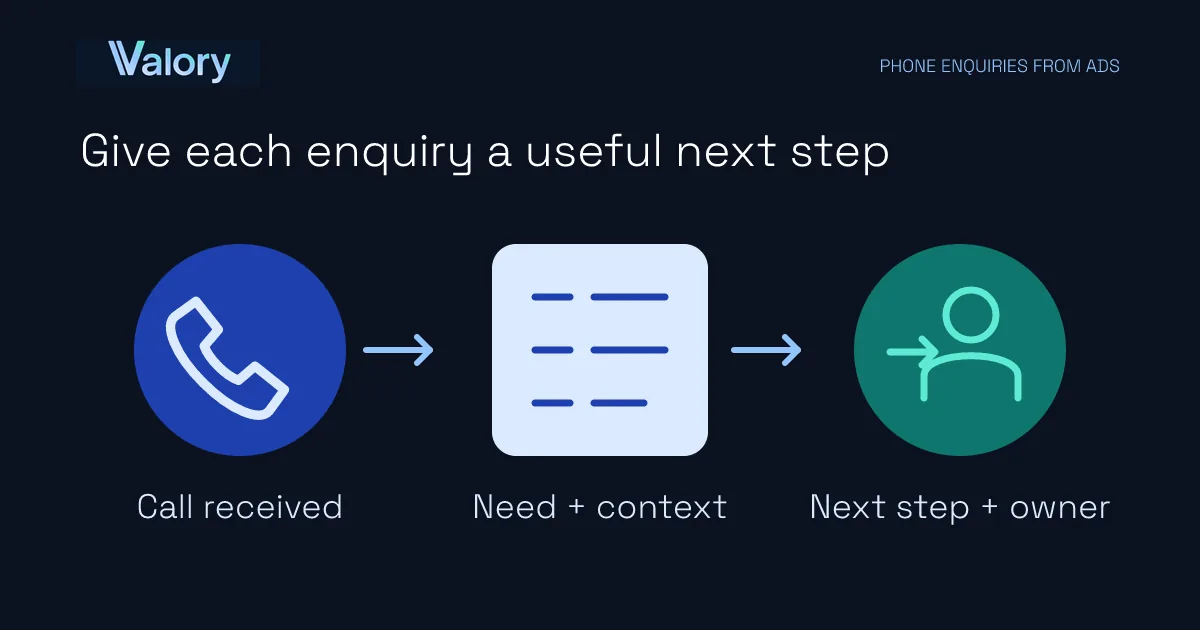
When an ad leads someone to call, the first job is to understand what they need, check whether your business can help and give them a useful next step.
Start with three practical changes to the way the call is handled:
- Check the fit early. Establish the service requested and the location when that affects whether you can help. Do this before collecting a long list of details.
- Be clear about the outcome. A quote request, preferred appointment time and confirmed booking are different things. Tell the caller which one has actually happened.
- Give unfinished work an owner. Someone needs to pick up the enquiry, including when the usual estimator, receptionist or business owner is away.
You can apply those steps using the phone arrangements and enquiry records you already have. They help you answer a more useful question than “How many calls did the ads produce?”: “Which callers could we help, and what happened next?”
A call count tells you only part of the story
An incoming call might be a prospective customer, an existing customer changing an appointment, a repeated attempt to reach you or someone asking for a service you do not provide.
Even the word “conversion” needs context. Google Ads documents several phone-conversion methods, including calls meeting a selected duration, clicks on a phone number and imported business outcomes. A click measurement is not proof that a conversation happened, and a duration-based conversion does not, by itself, establish a sale or suitable enquiry. Check which definition your existing report uses. Google's phone-conversion guidance explains the distinctions.
Google's call-reporting guidance also distinguishes details such as call duration and whether a call connected. Those facts are useful, but the business still needs to understand the request and its outcome.
Keep these meanings separate when reviewing enquiries:
| What you know | What it tells you | What remains to establish |
|---|---|---|
| A call reached the business number | There was an incoming call attempt. | Whether anyone answered and what the caller wanted. |
| The call lasted a certain time | The recorded duration. | Whether the conversation was useful, relevant or completed. |
| The request fits the service | The requested work appears to fall within your services, area and agreed acceptance rules. | Whether you have enough information for the next person to act. |
| The enquiry is qualified for follow-up | Your agreed criteria are met and there is enough relevant context to take the next step. | Whether the caller proceeds, the job is accepted or an appointment is confirmed. |
| A next step was requested or completed | A callback, quote, assessment or booking has a specific status. | Any remaining action and its owner. |
| Work was completed and paid | A later commercial outcome is recorded. | Which earlier enquiry it belongs to and what, if anything, the available evidence says about its source. |
A short call can establish a clear booking request. A long one can end with the discovery that you do not offer the service. Duration is context, not a substitute for the content of the enquiry.
Agree what a useful enquiry looks like for your business
“Qualified” should have a practical meaning that the person answering and the person following up both understand.
For a service business, it might mean the caller wants work you offer, the location is covered, the relevant requirements are understood and the team has enough information to arrange the appropriate next step. The exact requirements depend on the service.
Service fit is the first check. Readiness for follow-up is the next. A request might be in your area and within your services, but still need clarification about the site or appointment type. That is an incomplete enquiry worth clarifying, not automatically a poor lead.
Ask only what changes the next decision. For a quote, the useful facts may be the work requested, suburb, approximate scope, desired timing and checked callback details. A full address can wait until it is needed. An unknown measurement can remain unknown until the estimator decides how to assess it.
Use the quote enquiry intake template if your team needs a consistent place to capture those details. It separates known scope, missing information and the next owner.
Keep the advertised offer available to whoever answers. If callers mention a particular service, price or appointment offer, staff need the current approved details and any conditions. When the caller's understanding differs, clarify it before making a promise.
Three calls, three different outcomes
The following examples are fictional. They illustrate decisions a team might make, not customer results or campaign performance.
A trade enquiry outside the business's services
A caller sees an air-conditioning ad and asks for routine servicing. In this example, the business supplies installations but does not offer the servicing requested.
A brief service check establishes the mismatch. The caller gets a clear answer without a lengthy intake or an unnecessary estimator callback. The outcome is an unsuitable service request, even if the call is counted in an advertising report.
If the same misunderstanding recurs, review whether the ad and the page it leads to describe the offer clearly. One unsuitable call does not establish that an entire campaign is ineffective.
A cleaning enquiry ready for assessment
A building manager asks about recurring cleaning for shared stairwells in a complex. The business offers that service and covers the suburb. The caller provides the number of levels and preferred cleaning days, but access arrangements still need agreement.
The quoting team has enough to review the request and decide how to assess the site. The enquiry can be useful without a final specification. Its next step is an assessment discussion, with a named owner and the access question still visible.
Neither a quoted price nor a start date has been confirmed. The person answering should explain that distinction before ending the call.
A clinic enquiry with an appointment still pending
A new caller asks for an appointment type the clinic offers. They give a preferred day, but availability has not yet been checked.
Reception can record the appointment request and arrange the next administrative step. The preferred day remains a request until the clinic's booking process confirms it. A booking link sent to the caller is also a next step, not proof that they completed a booking.
Keep clinical questions with the clinic's appropriate staff and process. This example concerns appointment administration; it does not establish the caller's clinical suitability for treatment.
Finish the call with an accurate next step
The closing explanation should match what has happened.
If an enquiry has been saved for staff review, the caller can hear: “I've recorded the work you're asking about and your preferred timing. The quoting team still needs to review the details before confirming the next step.”
If an appointment is actually confirmed, provide the confirmed details. If the result is uncertain, leave it pending and have the responsible person check before making another attempt.
Agree any callback commitment with the team that has to deliver it. A caller saying “after lunch would suit me” gives you a preference; it does not mean someone has accepted that deadline.
The enquiry handoff guide provides a fuller format for recording the completed action, remaining work, owner and caller expectation. Those principles also apply to calls answered during business hours.
Follow the enquiry after the phone stops ringing
Someone should be able to pick up the record and know what to do without asking the caller to repeat the whole conversation.
For unfinished enquiries, make the next action specific: the estimator needs to discuss site access; reception needs to check appointment availability; the owner needs to decide whether an exception can be accepted. A message sitting in a shared inbox still needs an agreed person or team responsible for it.
Review open enquiries during a routine the business can sustain. Check whether the callback happened, whether the caller responded and whether the next action is still waiting on your team. Record a failed contact attempt as an attempt, rather than treating it as completed follow-up.
Also recognise repeat contact about the same request. A caller who tries again because nobody returned the first message should not appear to the team as a completely separate new opportunity. Use the existing enquiry reference and approved records to establish the connection; a matching phone number alone can be misleading when people share a number or have more than one request.
Use the outcomes to find the right problem
Look at a manageable sample of recent enquiries with the people who answer and follow up. You are looking for a pattern you can act on:
- Calls about work you do not offer: check whether the offer, service area and explanation are clear to callers.
- Suitable enquiries with missing basics: refine the few questions needed to prepare the next step.
- Useful enquiries waiting without an owner: fix the handoff and backup arrangement.
- Repeat calls about unanswered requests: check whether promised callbacks are being completed.
- Bookings or quotes that do not progress: review the later outcome before assuming the first call or the advertising was the cause.
Keep unknown results visible. If nobody has established what happened after a quote, leave its outcome unknown until someone checks.
Be equally careful about source. “I found you on Google” does not tell you whether the caller clicked an ad, an ordinary search result or a business listing. Retain what is actually known from your existing records and the caller's account. Do not label every call received while advertising is running as an advertising-generated enquiry.
Choose call cover around the job you need done
If suitable callers regularly arrive while the team is occupied, decide what the first answer needs to achieve. It may be a brief service check, useful quote context, an appointment request or a clear route to a person. Existing staff, an answering service or an AI receptionist can be considered against that actual scope.
Valory AI is a managed AI receptionist service for Australian businesses. We configure workflows to answer agreed questions, capture enquiries, book appointments where configured and escalate to staff. The business still needs clear acceptance rules and an owner for follow-up.
Our AI receptionist setup guide explains the preparation and testing involved. If you would like to work through the calls your advertising brings in, book a walkthrough with three typical enquiry types and the next steps you want callers to receive.