Published: 19 October 2026
Serving callers in another language: what your phone service needs to do
Plan business calls in another language. Choose staff, interpreting or AI support, check important details and keep the whole service understandable.
 By Matthew WalkerFounder, Valory AI
A caller may be comfortable asking a simple question in English but prefer another language when discussing a charge, explaining a problem or arranging a service. A friendly greeting helps, but the rest of the conversation still needs to work.
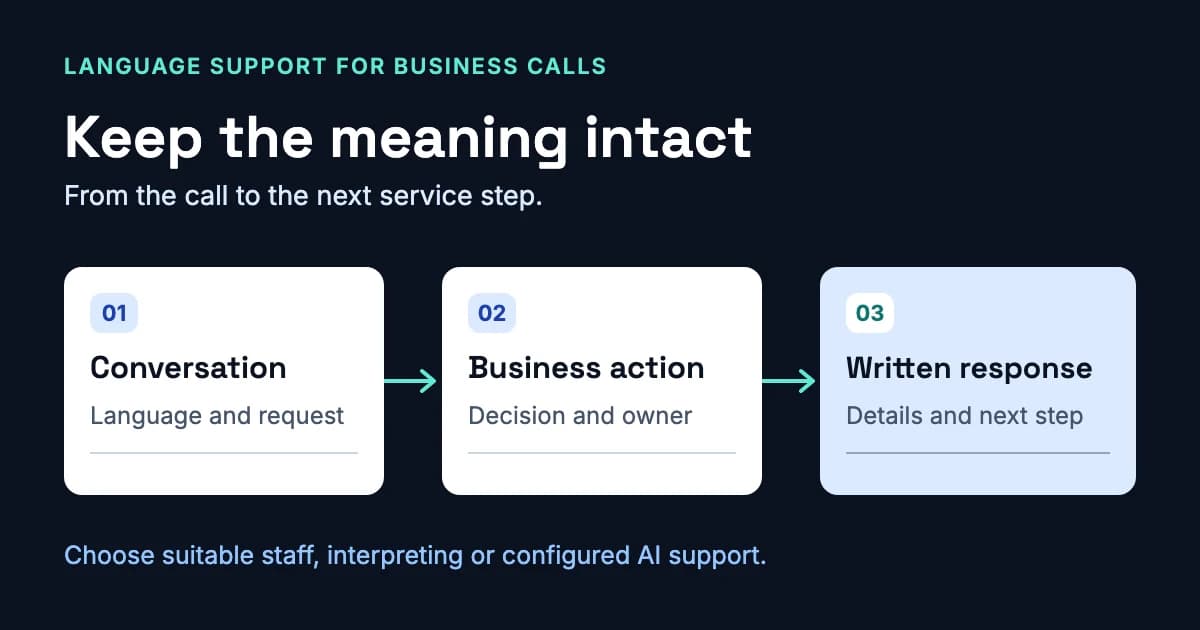
For a business, the practical question is whether both sides understand the request, the decision and what happens next. That may involve a bilingual staff member, a professional interpreter or an AI receptionist configured for a limited set of tasks.
Start with the conversation you need to support. Then choose the people, technology and checks that fit it.
Ask which language the caller wants to use
Do not choose a language from a person's name, nationality or accent. Someone speaking English with an accent may want to continue in English. Someone who begins in English may prefer another language for the detail.
Where your team can offer a genuine choice, make it simple: “Which language would you prefer for this conversation?” State the options that are actually available. Avoid offering immediate help in a language if the only person who speaks it is away.
If you cannot establish the caller's language, use your language-assistance provider's identification process instead of repeatedly guessing. Once a preference is known, check any language variety that matters to the service you are arranging.
Accents and language support are separate considerations. Our guide to accents and background noise explains how speech recognition and voice choice affect a call, including calls conducted entirely in English.
Choose the kind of help the conversation needs
Being able to speak a language is useful. It does not automatically qualify someone to interpret a complex discussion between other people.
NAATI explains the distinction between bilingual people and interpreters: interpreting involves transferring meaning accurately, with professional skills and ethical responsibilities beyond fluency alone.
These are different service arrangements:
| Arrangement | Useful role | What the business needs to establish |
|---|---|---|
| A bilingual staff member serves the caller directly | Handles routine matters within their own role and authority in a language they can use competently | The person's availability, task knowledge, authority and limits |
| A professional interpreter joins the conversation | Enables the caller and the responsible staff member to communicate across languages | Suitable credentials and subject knowledge, the booking arrangements and who makes the business decision |
| A configured AI receptionist handles an agreed task | May support routine questions or actions where the proposed language and workflow have been demonstrated | The exact language, task, information, action limits and alternative when communication breaks down |
The table describes choices to assess, not interchangeable guarantees. A simple opening-hours question and a discussion about consent or a disputed agreement deserve different preparation. For clinical, legal or other specialist matters, use the relevant professional process for language assistance.
Keep the authorised person responsible for their decision when an interpreter joins. An interpreter helps people understand each other; they do not become the business's service manager, adviser or clinician.
Check the complete AI conversation, not just the greeting
A supplier's language list is a starting point for questions. Ask what is included in the particular service being proposed to you.
For example, ElevenLabs documents language switching as a separately enabled tool that switches an agent's output among its configured languages. Its settings can also restrict when switching is allowed. Platform documentation does not establish what an individual reception provider has enabled, tested or agreed to support.
Ask to hear how the caller enters the chosen language, how a mistaken choice is corrected and what happens if they ask to change later. Check whether the receptionist can explain the actual service terms, rather than only introduce itself fluently.
The business action needs to remain accurate too. A request made in one language might generate a booking entry or staff message in another. Verify the meaning of that record, including corrections, uncertainty and anything the caller has declined. A plausible English summary is not enough if it changes the request.
Use the AI receptionist vendor checklist for the wider questions about responsibility, privacy and support. Language capability should be part of the agreed scope, with evidence for the tasks you intend to offer.
Make the important meaning explicit
Consider a fictional workshop with a bilingual service coordinator. A customer prefers Vietnamese and wants to “book the car in” for a fault check. The workshop can offer a drop-off appointment, but it cannot yet promise when the vehicle will be repaired.
The coordinator needs to establish what the appointment actually means: when the customer leaves the vehicle, what the workshop will assess and when it will discuss any proposed work. The customer should not leave believing that a drop-off time is a guaranteed collection time.
The following English wording illustrates the meaning to convey; it is not a translated script or a tested call:
“That time is for leaving the car with us for an assessment. We have not confirmed when the repair will be finished. Is that suitable for you?”
Then agree the details that matter to the visit. Say the full date, local time and location. Explain the service using ordinary words, and check any charge or approval step through the workshop's authorised process. If a term remains unclear, resolve it before relying on agreement.
This is a useful discipline for any language. Avoid bundling several decisions into one question and treating a single “yes” as acceptance of all of them. Give the caller space to ask questions or describe what they understand will happen.
Local names may also need to remain recognisable. A suburb, business name or product code should still identify the same place or item when it reaches the staff record. Ask for clarification instead of silently replacing an unfamiliar name with a familiar one.
Prepare for a call with an interpreter
Arrange the process before staff need it during a difficult call. Confirm how your chosen service is accessed, the language or specialist requirements, charges, availability and what happens when immediate help cannot be arranged. Do not assume that access is free or that a particular interpreter will be available at once.
The Department of Home Affairs describes TIS National's services, including immediate and pre-booked phone interpreting to help people communicate with agencies and businesses. Check the current arrangements for your organisation and situation directly with the service.
When the conversation begins, explain who is present and why. The TIS National guide for agencies recommends addressing the customer directly, using short sentences with one idea at a time, and leaving pauses for interpretation.
Keep the staff member who can deal with the matter involved. Connecting an interpreter without anyone authorised to answer the business question simply creates another incomplete conversation.
If the topic changes, reassess what support is appropriate. A routine appointment query may become a discussion about a sensitive complaint or an important decision. Explain the change and arrange the appropriate person and language assistance before proceeding.
Include written messages in the plan
The call may end with an appointment message, instructions, a quote or a request for documents. Check what language and format the customer can use for that next step. A conversation in one language followed by an unexplained English-only message can leave the work unfinished.
NAATI distinguishes interpreting from translation: interpreting supports spoken or signed communication, while translation deals with written material. A service that handles the call does not necessarily include suitable written translation.
For repeated messages, maintain a reviewed version of the content and update each language when the underlying service changes. Prices, cancellation terms, opening hours and required documents should not diverge between versions. Establish who is competent to review the wording and who owns those updates.
For an individual message, check that it reflects what was actually agreed. Keep a request distinct from a confirmed appointment and an estimate distinct from an authorised price. If translation has not been checked, do not use confident formatting to disguise the uncertainty.
Use approved channels for personal information and translated records. Our privacy and call-recording guide covers the separate questions about collecting, accessing and keeping phone information.
Demonstrate each language with a real business task
Before offering a new language route publicly, walk through it with someone competent to assess the language and the business meaning. Use fictional details and the actual phone route you intend callers to use.
Try an ordinary request, then introduce a meaningful change: a corrected address, a different appointment preference or a question about a condition. Check the spoken response and the resulting booking or staff record. If no booking should have been made, verify that too.
Also try a language change and a request beyond the agreed scope. Include familiar local names in another-language conversation, so a name alone does not send the call down the wrong language path. Review whether the caller can understand the available next step when the service cannot help.
Assess each proposed language and task on its own evidence. A successful English demonstration does not establish another language's performance, and a small sample cannot prove a universal accuracy rate. Keep the demonstrated scope narrow enough to describe honestly.
Begin with one useful service you can support throughout
Choose a caller need, a language and a complete service step. Decide who can handle it, who can check its meaning, and what happens when the conversation needs more support. Include the written response and later staff contact in that decision.
After introducing the service, review examples where customers needed corrections, repeated the same request or could not complete the intended step. Ask whether the information and next action were understandable. More calls answered alone does not establish better language access.
If you are assessing managed reception, book a walkthrough with a language and a typical call in mind. We can discuss the required scope, what would need to be demonstrated and where staff or professional language assistance would still be needed.