Published: 15 October 2026
Can an AI receptionist understand accents and background noise?
Can an AI receptionist understand Australian accents and noisy calls? Learn what affects accuracy, how corrections should work and what to ask a provider.
 By Matthew WalkerFounder, Valory AI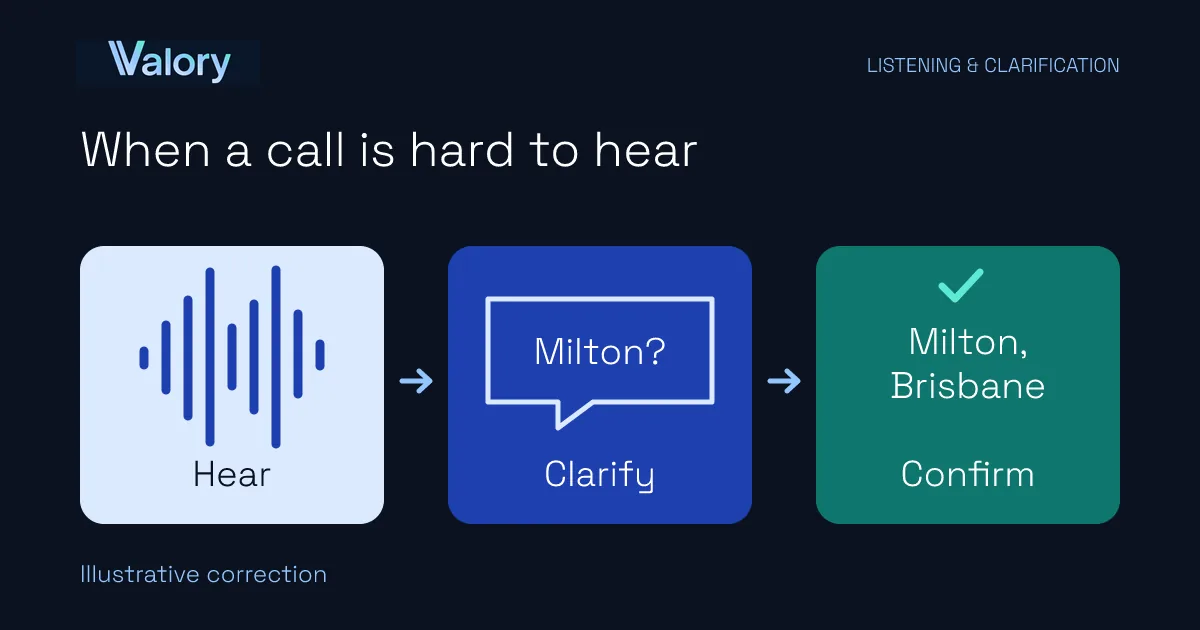
Yes, an AI receptionist can understand a range of accents and work with some background noise. How well it handles your callers depends on the speech system, the audio reaching it and the way the conversation is designed. A clear demonstration in a quiet office cannot establish how it will perform for everyone who rings your business.
For an Australian business, the useful question is specific: can it understand the people who actually call, check the details that matter and give them a workable next step when something is unclear?
That includes someone asking for a staff member by name, a customer ringing from a busy shop and a caller who pauses while finding their appointment details. Good reception needs to accommodate those situations without asking people to change how they normally speak.
An Australian voice and accurate listening are different things
The voice you hear is only one part of the service. Three capabilities are often bundled together in a demonstration:
| Capability | What it means | What to establish |
|---|---|---|
| Speaking voice | How the receptionist sounds to callers, including its accent and pronunciation. | Can callers comfortably understand it? |
| Speech recognition | How the system identifies the words a caller says. | Does it understand your callers and retain corrections? |
| Language support | Which languages the complete conversation and workflow can handle. | Which languages are supported in your proposed setup, and what happens outside that scope? |
Choosing an Australian-sounding voice does not, by itself, demonstrate recognition of Australian callers. ElevenLabs, for example, documents the accent of generated speech as a property of its voice output, while its speech-to-text documentation describes turning incoming speech into text. The buyer implication is to listen to both sides of a demonstration: the reply and whether it reflects what the caller actually said.
Likewise, understanding someone speaking English with an accent is different from conducting the call in another language. If your customers need another language, ask for that complete workflow to be demonstrated. A list of languages supported by an underlying technology does not establish what an individual receptionist service has configured and supports.
What makes a call harder to understand?
Accents are normal variations in speech. They are one part of a larger picture that includes speaking pace, vocabulary, microphone quality and the surrounding sound. Microsoft's speech testing guidance recommends representative speakers, speech variations, environments and devices when evaluating a speech model.
For a business buyer, that means a single employee reading a script is a narrow demonstration. Include willing people who reflect the range of callers you serve, speaking in their own voices and using ordinary phrasing.
Some difficulties are about missing context. A suburb, surname or product name may be less familiar to the speech system than the rest of the sentence. Others are about the signal: a word obscured by nearby conversation, echo or a poor connection. Treating every misunderstanding as an “accent problem” can lead to the wrong fix.
Consider a caller who says, “Can I speak to Jo about the quote?” The system may hear the sentence correctly and still need to establish which Jo they mean. Better recognition alone cannot resolve an ambiguous staff directory.
How much background noise can voice AI handle?
There is no useful universal promise that an AI receptionist will handle a “noisy environment”. The kind of noise, its volume relative to the caller and the audio path all matter.
Google's speech-recognition guidance notes that excessive noise and echo can reduce accuracy, and that overlapping speakers can be interpreted as background noise and ignored. It also warns that adding noise-reduction processing can reduce accuracy for its service. Noise cancellation is therefore something the provider should validate for its actual system, rather than a feature name to accept as proof.
An everyday demonstration might include a caller speaking on a handset with conversation in the room, then on speakerphone. Keep the request the same so you can hear what changes. If customers often ring from workshops or busy venues, discuss those conditions specifically.
When the audio is unclear, a useful response is a focused request: “I missed the street name. Could you say that again?” Asking for the whole story again makes the caller do unnecessary work. If the connection remains unusable, the service needs an agreed alternative, such as a transfer, a callback request using a checked number, or another contact channel your business supports.
Names, numbers and suburbs deserve particular attention
A conversation can sound fluent while carrying one consequential error. The agent may understand that someone wants a quote, yet record the wrong callback number. It may hear most of an address correctly but send the request to the wrong location.
Confirm details according to what the business will do with them. For a callback, a usable contact number is essential. For location-based work, the suburb and address may determine whether the business can help. For a named-person request, the correct staff member or team matters more than a perfectly polished transcript.
Provide the supplier with the relevant service names, staff names, common aliases and locations. Some speech systems support vocabulary hints: Google's model-adaptation documentation describes ways to favour relevant words and names, while noting that stronger bias can also introduce incorrect words. Availability depends on the provider and configuration. A business knowledge base and a speech-recognition vocabulary are not automatically the same feature.
Ask how those details are used, then hear an example. Do not assume that pasting a list into a setup form resolves every pronunciation or recognition issue.
For the operating work behind staff directories and aliases, see our guide to tuning staff-name recognition and call routing.
What should happen after a misunderstanding?
The quality of recovery matters as much as the first attempt. The receptionist should acknowledge the correction, confirm the detail that changed and use the corrected value in the next action.
Here is an illustrative exchange, not a recording or a result from a Valory AI deployment:
Caller: “The job is in Milton.”
Receptionist: “Was that Minto?”
Caller: “No, Milton, in Brisbane.”
Receptionist: “Thanks — Milton, Brisbane. Is that where you need the service?”
The conversation is only part of the check. The request passed to staff should also say Milton, Brisbane. A corrected spoken reply followed by an incorrect message still leaves the business with a problem.
If the receptionist cannot establish a detail, it should preserve that uncertainty and use the agreed fallback. It should not silently choose the most plausible address, invent a spelling or keep the caller in a repetitive loop. A person asking to speak to staff should receive a clear explanation of the available route, including what happens when nobody can answer.
Pacing matters here too. The caller needs time to spell a name or finish a number, and a way to correct a readback. ElevenLabs' conversation-flow documentation describes separate controls for interruptions and how readily an agent takes its next turn. Those settings illustrate why a fast response alone is not enough. Our AI receptionist latency explainer covers response timing in more detail.
What evidence is useful before you choose a service?
Ask to hear a phone demonstration of the proposed setup using fictional contact details and familiar business requests. A browser demonstration is useful for conversation, but it does not reproduce every part of the telephone path your customers will use.
Look for three things: whether the request is understood, whether important details are checked, and whether the final message or action matches the corrected conversation. Include a natural pause, a correction and realistic background sound. The purpose is to find the conditions the service can handle and the situations where people need another route.
If a provider quotes an accuracy percentage, ask what it measures. Speech recognition is often evaluated using word error rate: inserted, omitted and substituted words compared with a reference transcript. Microsoft's accuracy guidance explains that measure. It does not tell you whether a particular call produced the right callback number, recipient or booking. Ask about the test audio, caller mix and phone setup as well as the score.
A small demonstration can reveal a problem; it cannot establish a universal success rate. Use the AI receptionist vendor checklist for the wider questions about scope, support, ownership and failure handling.
Choose a setup that fits your callers
You do not need to select a speech model yourself to make a sound buying decision. You do need a provider that can explain the proposed service, demonstrate it with relevant callers and conditions, and show how corrections reach the person doing the follow-up.
Valory AI provides managed AI receptionists for Australian businesses. If accents, local names or noisy calls are a concern, bring examples of the situations your team encounters to a walkthrough. We can discuss the call flow and what would need to be demonstrated for your business, including the fallback when a caller cannot be understood.