Published: 17 October 2026
How to read a business phone report: calls, requests and results
Understand what answered calls, bookings and success rates actually measure. Use a worked example to read business phone reports and choose a useful improvement.
 By Matthew WalkerFounder, Valory AI
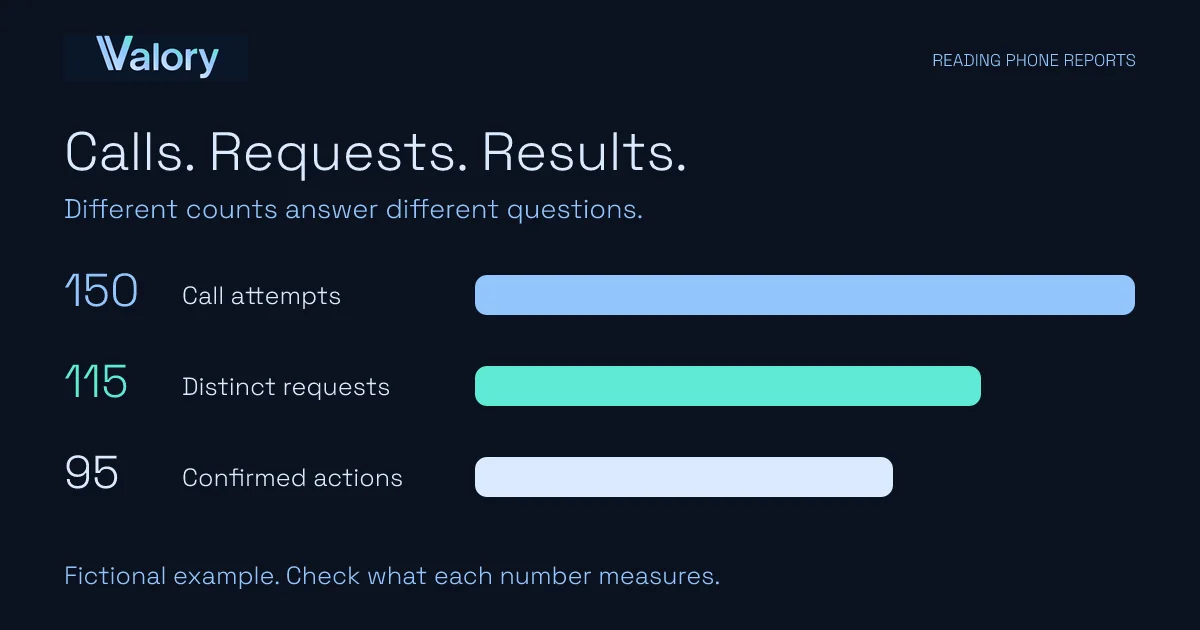
A phone report can tell you how often the phone rang, how many conversations took place and what callers asked for. It can also leave an important question unanswered: did the customer get what they needed?
The distinction matters when you are reviewing reception cover, deciding where staff spend their time or comparing an AI receptionist with your current process. A higher answer rate may be useful. It does not, by itself, show that more appointments were confirmed or more problems were resolved.
Start by separating three things: call attempts, customer requests and completed actions. Then check the evidence behind each number.
A worked example: 150 calls are not 150 opportunities
The following numbers are fictional. They illustrate a method, not a customer result or an industry benchmark.
A service business reviews 150 original incoming call attempts across one complete week. The team checks the relevant records and follow-up evidence, including calls that did not initially connect. It can classify all 150 attempts in this example.
| First outcome of the incoming attempt | Customer-related attempts | Known spam, wrong numbers or tests | Total |
|---|---|---|---|
| Conversation with staff or AI receptionist | 105 | 15 | 120 |
| Voicemail only | 8 | 2 | 10 |
| No connection | 17 | 3 | 20 |
| Total | 130 | 20 | 150 |
Using all incoming attempts, the conversation answer rate is 120 ÷ 150 = 80%. For customer-related attempts, it is 105 ÷ 130 = 80.8%, rounded to one decimal place. These are different measures because they use different groups.
The business also finds 15 repeat attempts about requests already counted. That leaves 115 distinct customer requests across the 130 customer-related attempts.
Removing repeats is appropriate when counting requests. Keep them when measuring phone workload: someone still had to deal with each attempt. A repeat call can also reveal a missed update or unresolved problem.
In a real report, some unanswered calls will remain unclassified. Keep an “unknown reason” group instead of treating them all as sales leads or silently excluding them. Likewise, a familiar phone number is a clue, not proof that two calls concern the same request.
Check what “answered” means
Your phone system and your business may use the same word differently.
A network can record a successful connection when the caller reaches a voicemail greeting. For example, Twilio's Call resource documentation explains that a call marked completed can have connected to a person, a phone menu or voicemail. That status describes the connection; it does not establish that a person helped the caller.
Ask what your report counts as an answer. Is it a connection to the phone system, a conversation with a receptionist, or a completed customer request? Are voicemail and short abandoned calls shown separately? Does a transfer create an additional record for the same original call?
There is nothing wrong with tracking each of these events. The problem starts when their labels make them look interchangeable.
For reception coverage, one useful measure is the share of incoming attempts that reached a staff member or AI receptionist. For customer service, you also need to know what happened during and after those conversations.
Count the original call once
Imagine a caller reaches reception and is transferred to a service adviser. A phone system may create a record for the incoming connection and another for the transfer. Those are two parts of one customer call, not two new enquiries.
Start your count at a clear point, such as incoming attempts to your main business number. Keep transfer records available to assess whether the connection worked, but do not add them to the incoming total.
Choose a complete reporting period, record its time zone and use the same business-hour definition each time. A Monday-to-Friday report and a seven-day report answer different questions. So do local business hours and a fixed national time window.
The method should be understandable without knowing the phone provider's internal terminology. If you cannot explain the denominator in one sentence, ask for the report definition before comparing percentages.
Match each request to a meaningful result
The fictional business gives every request one primary purpose so the groups do not overlap. In practice, a call can contain several tasks; if you count those separately, label the measure as tasks rather than unique callers or enquiries.
At a fixed review time, its 115 requests look like this:
| Primary request | Requests | Required action confirmed | Still awaiting action | Outcome unknown |
|---|---|---|---|---|
| Appointment booking | 40 | 30 | 6 | 4 |
| Routine information | 50 | 45 | 3 | 2 |
| Staff callback | 25 | 20 | 3 | 2 |
| Total | 115 | 95 | 12 | 8 |
For this example, a confirmed booking means the agreed appointment is saved in the booking system. An information request counts when a reviewer can verify that the relevant approved information was provided. A completed callback requires a record of the staff conversation and its action, not just a dial attempt.
Each definition has a limit. Providing an answer does not establish satisfaction. A saved appointment does not establish attendance or payment. A completed callback may lead to further work.
The booking action rate is 30 ÷ 40 = 75%. Dividing the same 30 bookings by all 150 incoming attempts would give 20%, but it would combine booking demand with information requests, existing-customer calls and spam. That figure would not tell the team how well it handled booking requests.
The 12 pending and eight unknown outcomes also need different attention. Pending means the required action is known to remain open. Unknown means the evidence does not establish what happened. A later review may change both counts, so record when the outcomes were checked.
Look behind an AI “success” label
An automated quality assessment can help identify calls to review. Read its definition before treating it as a business result.
ElevenLabs' success-evaluation documentation, for example, describes model-based assessment of the conversation transcript against configured criteria. It can return success, failure or unknown. That is useful evidence about the conversation, with a different basis from a booking-system record or a completed payment.
Consider a receptionist saying, “You're booked for Tuesday.” The transcript proves those words were said. To count a confirmed booking, check that the appointment was actually saved with the agreed details. If the booking record is unavailable, preserve that uncertainty.
The same applies to transfers. “I'll put you through” is an intention. A transfer attempt is an action. Evidence that the intended person answered is a further result.
When evaluating a provider, use the AI receptionist vendor checklist to ask how these outcomes are distinguished in the proposed service.
Use the report to choose an operational change
The useful question is what the numbers suggest checking next.
If many customer calls do not reach reception, examine when they arrive and how the phone is routed. If conversations happen but booking requests remain open, check appointment availability, permissions and the booking process. More answering capacity may not address that problem.
If callbacks are the largest unfinished category, look at the team's follow-up workload and the promises made to callers. If the unknown group is large, first improve the evidence. A confident percentage built from incomplete records will not help you choose the right change.
Review a small selection of completed, pending and unknown requests alongside the totals. Include difficult calls and repeat contacts. Choosing only polished examples can hide the reason customers are calling again.
For a broader rollout, the pilot-to-production playbook explains how to connect that review to a defined workflow and launch criteria.
Compare like with like over time
A change from 30 to 40 bookings is hard to interpret without knowing whether booking enquiries also increased. Compare the same request category, reporting window and completion definition. Record changes to opening hours, advertising, staffing, service availability and call routing that could affect the result.
Show counts beside rates. Five completed requests out of six can change sharply with one extra outcome. A longer observation period may help, but it will not fix an inconsistent definition.
Keep financial conclusions separate. To estimate value, follow genuine enquiries through the relevant business outcome and account for existing callbacks or online bookings. Our missed-call cost guide explains how to use assumptions without treating every unanswered call as lost revenue.
Start with one question your team needs answered
You do not need a new dashboard to begin. Choose one question, such as “Are booking enquiries reaching a confirmed appointment?” or “Are promised callbacks happening?” Agree what counts, where the evidence lives and who reviews the exceptions.
If you are considering managed reception, book a walkthrough with two or three typical call types in mind. We can discuss the intended outcomes, the records needed to check them and what would need to be confirmed for your setup.