Published: 15 October 2026
How to switch answering services and keep your business number
Changing answering services? Keep your business number where supported, plan forwarding or porting, check messages and staff handoffs, then close the old service.
 By Matthew WalkerFounder, Valory AI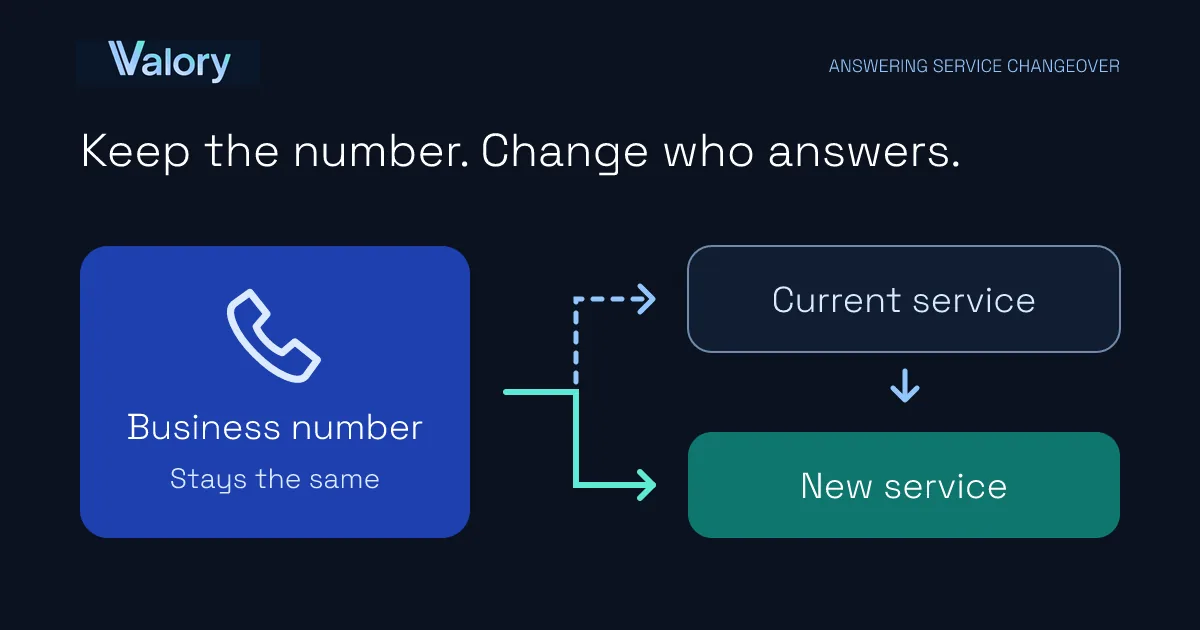
In many cases, you can change answering services and keep the business number customers already use. If that number stays with your existing telco, the change may be a new forwarding destination. If it needs to move to another telco, you will need an accepted number-porting arrangement.
Start by confirming who controls the number and how calls reach the current answering service. Prepare and test the new service, agree the change window and fallback, then check calls and messages before ending the old answering arrangement. If you are porting, keep the number active during the transfer.
The work is manageable when the number, call route and follow-up responsibilities are clear. Customers can keep the same contact number where retention is supported, while your team changes what happens behind it.
First, identify the number customers actually dial
There may be two different numbers involved:
- Your published business number: the number on your website, invoices, signage and customers' phones.
- The answering destination: the number your telco or phone system sends calls to so the current answering service can pick up.
If you have always forwarded your own business line to an answering destination, you may only need to replace that destination. The old answering service's internal number does not necessarily need to move with you.
If the answering company supplied the number you advertise, establish what happens to it when you leave. Ask who the account holder is, which provider manages the number and whether you can retain or transfer it. Get the answer in writing before scheduling cancellation.
A recent bill and your service agreement are useful starting points. Confirm the account name, number or numbers involved, and the person authorised to request changes. If a reseller, IT company or former employee manages the account, resolve access and authority early.
ACMA explains that the receiving telco must obtain permission and check the account holder before a port. It also notes that a new telco does not have to accept every port request, so confirm acceptance before committing to the change. See ACMA's number-retention guidance.
Decide whether to forward calls or port the number
Changing who answers does not automatically require changing telcos.
| Approach | What changes | What you need to confirm |
|---|---|---|
| Keep the number with the current telco and change forwarding | The destination for the calls you choose to divert. | Supported forwarding rules, charges, the new destination and how to restore the previous route. |
| Keep the current phone system and change its answering route | A queue, schedule or destination in the existing system. | Who administers the system, the affected call paths and the fallback route. |
| Port the number to another telco | The provider responsible for the number. | Port acceptance, account details, timing, service dependencies and the fallback available after the move. |
Forwarding can suit a business that is happy with its current phone service and wants different answering cover. You can agree whether the new service handles every call, unanswered calls or a scheduled coverage period, subject to the phone service's capabilities. Telstra's mobile forwarding guidance, for example, distinguishes immediate, unanswered, busy and unreachable diversions. The available method depends on your provider and service.
Use our Australian call-forwarding guide for carrier instructions once you have chosen the intended route. Changing a destination and checking the result is a separate job from preparing the receptionist to handle the call well.
Porting may be appropriate if you also want a new phone provider or cannot get the routing you need from the current one. Ask the receiving provider to confirm the process for your exact number type. Local, mobile and inbound numbers can have different arrangements; an estimated date for another business is not your changeover date.
Do not disconnect the number to start a port. ACMA's porting rules state that only an active service can be ported. Ask the providers which services the port will end and which contracts will remain. A phone number, answering subscription and internet service may need separate treatment.
Move the reception brief as well as the calls
Before redirecting customers, give the new provider the current rules your business wants it to follow. Check them with the staff who receive the enquiries; an old script may contain outdated hours or a person who no longer handles that work.
The useful briefing covers the greeting, hours, common requests, approved answers, information to collect and situations that should go to staff. For each call type, name the recipient and the alternative when that person is unavailable. Agree what the receptionist can tell callers about callbacks, appointments and response times.
This is especially important when changing the service's scope. If the previous provider transferred calls and the new plan only takes messages, staff need to know what has changed. If booking is included, confirm the appointment types and calendar actions actually supported.
Test the destination as well as the conversation. A well-handled enquiry has little value if it goes to an abandoned mailbox or an employee who thinks someone else owns it. Our enquiry handoff guide explains how to make the next action clear.
Keep pending messages and texts accounted for
A change of answering service should not leave yesterday's enquiries in an account nobody checks.
Before the switch, identify open callbacks, appointment requests and other unfinished work in the old service. Assign those items to staff and confirm how long the team will retain access to the old portal. Save the records your business needs through the provider's agreed export process, with appropriate access and retention arrangements.
Agree who will check for messages received just before the change and who will handle any delayed notifications. If both services are available during a transition, make clear which one handles each call route and how duplicate enquiries will be recognised.
Treat SMS separately. If customers text the business number, establish where those messages will arrive after the change and who can reply. Also check any outbound caller-ID or messaging functions your staff rely on. A successful incoming phone call does not demonstrate those features or move the old message history.
Choose a change window with people available to help
Pick a time when the business owner, the person changing the route and the new provider can check the result together. A quieter period is useful, but support availability matters too. Avoid making the change just before everyone leaves if nobody can investigate a problem.
Agree the affected numbers and routes, who makes each change, when testing begins and who decides whether to continue. Include any separate advertising numbers or department lines that also reach the old answering service.
For a port, use the receiving telco's confirmed arrangements and ask what interruption to expect. ACMA's switching guidance says customers must be told about expected interruption and the consequences of ending the previous service. Build the change window around those details rather than a general promise of a seamless switch.
Have the fallback ready before changing anything:
- For a forwarding change, record the working destination, schedules and conditions so the authorised administrator can restore them if needed. Keep that destination available for the agreed transition.
- For a port, agree a recovery option with the receiving provider, such as routing to an available staff line where supported. Do not assume that changing an old forwarding setting will undo a completed port or that moving back is immediate.
Write down the support contacts and the problem that would trigger the fallback, such as calls failing to connect or messages reaching the wrong team. This gives the people managing the change a clear decision to make.
Test the published number and the staff handoff
Before the switch, test the prepared answering service using its agreed test route. After the switch, call the number customers actually use. A direct test of the new destination does not prove that the published number reaches it.
Use fictional caller details and agreed recipients. Cover the paths your business relies on:
| Check | A useful result |
|---|---|
| Ordinary incoming call | The published number reaches the intended service and gives the correct business greeting. |
| Overflow or closed-hours call | The agreed condition sends the call to the right destination; another voicemail does not intercept it unexpectedly. |
| Named staff member or transfer, if included | The right person receives the call or the agreed no-answer fallback occurs. |
| Message or callback request | The intended staff recipient receives accurate details and understands the next action. |
| Booking or other connected task, if included | The resulting record matches what the caller was told. |
| Text message and outbound call, where used | Messages reach the expected place and the outgoing call displays the agreed identity. |
Ask the receiving staff member to confirm delivery. Hearing “I'll pass that on” is not the same as checking the message in their inbox. Resolve a material failure before treating that path as ready.
Keep a short record of the results and review the first operating period with the team. That helps catch a forgotten route or a recipient who needs different information without turning the changeover into a large project.
Close the old answering arrangement after validation
Once the required routes and handoffs are working, finalise the old answering service's end date under its notice terms. Arrange the notice early enough to avoid unnecessary overlap, while keeping the service available for the agreed validation and fallback period.
Be precise about what is ending. If the business number remains with the existing telco and forwards to the new answering service, that telco service still needs to remain active. Ending the old answering subscription is a different instruction from cancelling the line customers call.
If the number has ported, obtain the receiving telco's completion confirmation and establish what remains on the old account before cancelling anything else. Check the final bill, export access and any related services you intend to keep. Remove obsolete recipients and system access once they are no longer needed.
The changeover is complete when customers reach the intended service, staff receive usable enquiries and the old arrangement has no unfinished work or unexpected dependency.
Planning a move to a managed AI receptionist?
Valory AI provides managed AI receptionists for Australian businesses. We design phone workflows around agreed questions, enquiry capture, bookings where configured and escalation to staff.
If you are considering a move from an existing answering service, book a walkthrough and bring your number provider, current answering arrangement and the coverage you want to change. We can work through the proposed call flow and what needs to be checked before customer calls are redirected. Number routing and any porting requirements depend on the providers and service involved.