Published: 15 October 2026
Workshop phone calls: handling “is my car ready?” and new enquiries
Handle vehicle progress calls and new workshop enquiries with clear update ownership, repair approval handoffs and realistic booking expectations.
 By Matthew WalkerFounder, Valory AI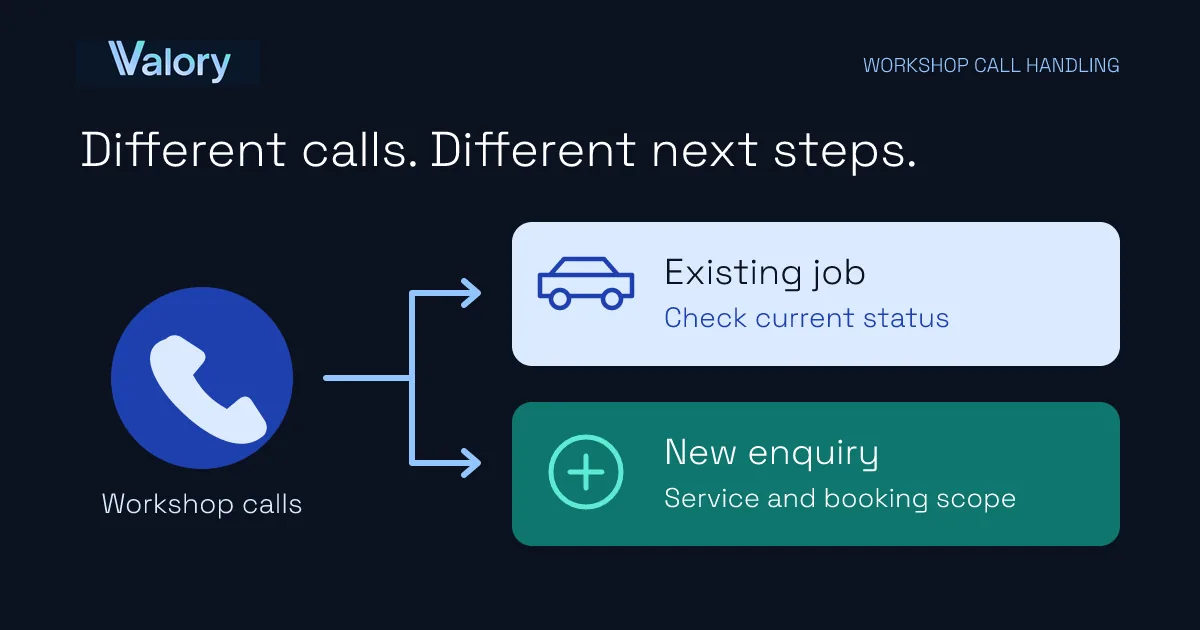
A customer whose car is already in your workshop needs an accurate update. A driver calling about a new service or fault needs to know whether you can help and what happens next. Sending both calls through the same “someone will call you back” routine leaves the service adviser to work out the difference later.
Start by separating the reason for the call, then give each type an owner. Progress updates should come from current workshop information. New enquiries should capture enough context for a booking or assessment. Calls about repair approval need to reach the person managing that work.
This can work with a receptionist, the owner, a rotating phone role or an overflow service. The important part is what each person can reliably answer while the technicians are working.
Ask about the job before asking for the whole story
A useful opening is:
“Are you calling about a vehicle already with us, an existing booking, or a new service or repair?”
An existing customer may be asking about a different car. A new caller may be returning a message on behalf of someone whose vehicle is already in the workshop. Route the request by the work involved, rather than simply by whether you recognise the name.
| Reason for calling | What the caller needs | Who or what can resolve it |
|---|---|---|
| “Is my car ready?” | Current progress, collection confirmation or a clear next update | An authorised person with current job information, or the adviser who will check it |
| “I'm returning your call about the extra work” | An explanation and the correct approval process | The adviser responsible for the estimate or repair authority |
| “Can I move tomorrow's service?” | A change to an existing booking | The person or system authorised to change that booking |
| “Can you service my car?” | Service fit and a confirmed booking or booking request | Approved service information and the workshop's scheduling process |
| “The car has started making a noise” | A path to assessment | Intake followed by the workshop's technical or urgent-call process where needed |
The first question saves the customer from repeating their vehicle's history to someone who only needs to find the existing job.
A job stage is not always a collection answer
“Inspection complete”, “waiting for approval” and “ready for collection” tell you different things. Someone answering the phone needs to understand what the recorded stage allows them to say.
For example, an inspection may be complete while the adviser is still preparing an estimate. Parts may have arrived while the repair remains unfinished. A booking marked for this afternoon does not establish a collection time.
Use one agreed place for current job information. Workshop Software's customer workflow documentation shows job status and comments on the working job record. Your workshop may use a different system. The practical requirement is that whoever answers can find the latest authorised update and tell when it was recorded.
Agree which updates the front desk may relay and which require an adviser. A useful distinction is:
- Received or awaiting inspection: the vehicle is at the workshop; findings and completion time may still be unknown.
- Inspection or diagnosis in progress: staff are assessing the issue; do not turn the caller's suspected fault into a confirmed diagnosis.
- Awaiting approval, parts or further work: explain only the recorded position. Each dependency may affect the schedule.
- Ready for collection: the responsible workshop person has confirmed that the vehicle can be collected under the agreed arrangements.
Before giving job-specific information, follow the workshop's process for checking the caller is entitled to receive it. Knowing a registration number helps locate a vehicle; it does not, by itself, establish that someone can approve work or collect it.
If the record is missing, old or inconsistent, say what needs checking:
“I don't have a confirmed collection time yet. I'll ask the service adviser to check the job and contact you.”
Use that wording only when someone has accepted the follow-up. Give a time window if the workshop can commit to it. The customer's need to collect at three is important context for the adviser, but it is not confirmation that the car will be ready at three.
Set the next update at drop-off
A progress call may be the customer's way of finding out whether they should arrange a lift, extend a hire car or change their afternoon. At drop-off, agree how and when the workshop will next contact them.
Separate an update time from a completion estimate. For example:
“We need to assess the fault before confirming the repair and timing. We'll call you with an update by the time we've agreed, even if the assessment is still underway.”
Choose a time your team can actually meet. Record the contact method, responsible adviser and any important collection constraint. If the promised update is approaching and the result is still uncertain, contact the customer with that uncertainty instead of waiting for a finished answer.
A short message can explain the current position and next contact. A ready-for-collection message should only follow a confirmed readiness decision. Workshop Software's communication guide describes sending customer SMS messages, including collection notifications. A messaging feature provides the delivery channel; your team still owns the accuracy of the message and any reply that needs attention.
Offer a phone update when texting does not suit the customer. Sending a message should not make it harder to ask a question about the repair.
Keep repair approvals out of the routine progress queue
A customer returning a call about an estimate may be the person whose decision allows work to proceed. Treat that differently from a request for a general update.
The person taking the call should establish which vehicle and estimate the customer means, then connect them to the responsible adviser or use the workshop's approved authorisation process. Questions about the findings, options, cost or changed scope belong with someone who can explain them.
If you are only taking messages, “the customer called to discuss the estimate” is the accurate record. Do not change the job to approved or tell the technician to proceed because a message sounds positive. Where telephone approval is part of your process, the authorised staff member should record the specific work and amount agreed, who approved it and when.
NSW Government repair guidance distinguishes diagnosis from repairs and says repairers must limit work to what the customer has authorised. The Motor Trade Association of South Australia's sample repair authority also separates requested and additional repairs. These sources reinforce a useful operating rule: receiving an enquiry, explaining an estimate and recording approval are different events.
Give new enquiries a route into the workshop
The other side of the phone needs attention too. A driver asking whether you service their make of car should not disappear behind a queue of progress calls.
For a routine service, establish the vehicle, service requested and preferred timing. Answer from the workshop's approved service information. If the booking process can confirm a suitable slot, confirm the actual booking details. If it cannot, make clear that you have recorded a request for the team to review.
A repair enquiry needs a little more context:
- the make and model, and the identifier your team uses to locate or create the record;
- the issue in the caller's own words and when they noticed it;
- whether they are asking for an assessment, returning about previous work or responding to an estimate;
- their timing constraints and the best way to contact them.
Ask only questions the next person will use. Do not diagnose a fault from a short description or promise a fixed repair cost from an unverified symptom. If the caller asks whether a vehicle is safe to drive, follow the workshop's approved safety pathway to a qualified person; routine intake is not a vehicle safety assessment.
Be precise about what a time slot means. A confirmed drop-off or diagnostic appointment does not automatically confirm the repair scope, parts availability or completion time. Explain any approved diagnostic charge and authorisation arrangements through the workshop's normal process.
For standard services, online booking can offer a convenient next step. For uncertain faults, a conversation may be needed first. The phone and online booking guide explains how to keep both routes available without forcing every caller through the same process.
Decide what needs the adviser now
Separating calls does not require a long phone menu or a second phone number. One opening question and a visible owner can be enough.
Consider this fictional example. During a busy afternoon, one customer asks whether their vehicle is ready, another returns a call about additional work, and a third asks for a service next week.
The first caller's job has no current collection confirmation. The phone handler records the collection constraint and assigns the status check to the adviser. The second call follows the approval pathway because the adviser needs to discuss the proposed work. The third follows routine service intake and the approved booking process.
All three callers receive a relevant next step. The technician is not asked the same general question three times, and the new service enquiry has an owner.
Your priority rules should also account for a missed promised update, a customer already waiting to collect, a complaint, or a safety concern. Choose a backup when the usual adviser is unavailable. The peak-period call guide covers staffing and overflow choices; apply those choices to the workshop's actual call types.
Where overflow answering can help
An answering service or AI receptionist can cover agreed first-contact tasks: identify the call reason, answer approved routine questions, capture the enquiry and pass it to the right person. Suitable appointments can be booked where the configured scheduling process confirms them.
A reliable answer about a car already in the workshop requires access to current, authorised job information. Without that, the useful action is to arrange a status check. Do not assume that an answering provider can read your workshop system, interpret a diagnosis or approve additional work.
Before adding coverage, work through a new service enquiry, an uncertain collection request and an estimate callback. Check who receives each request, what the caller is told and who acts if the adviser is unavailable.
Check whether the arrangement helps customers and staff
Review a small sample through your existing records and privacy process. Separate new enquiries from current-job calls, then look for practical failures: repeat status calls without an update, missed callback commitments, unclear approvals and new enquiries that never reached an owner.
Compare similar busy periods. Fewer progress calls may indicate better updates, but it could also reflect fewer vehicles in the workshop. More messages captured does not establish more bookings or paid repairs. Look at the next action and its outcome as well as the call count.
If you are considering managed coverage, see Valory AI's mechanic answering service. Bring the three call types above to a walkthrough so we can discuss the intake, staff handoff and booking scope your workshop actually needs.