Published: 17 October 2026
Handling customer complaints by phone: what to say and what happens next
Handle customer complaints by phone with a clear first response, an authorised decision and a useful update. Practical examples for Australian service businesses.
 By Matthew WalkerFounder, Valory AI
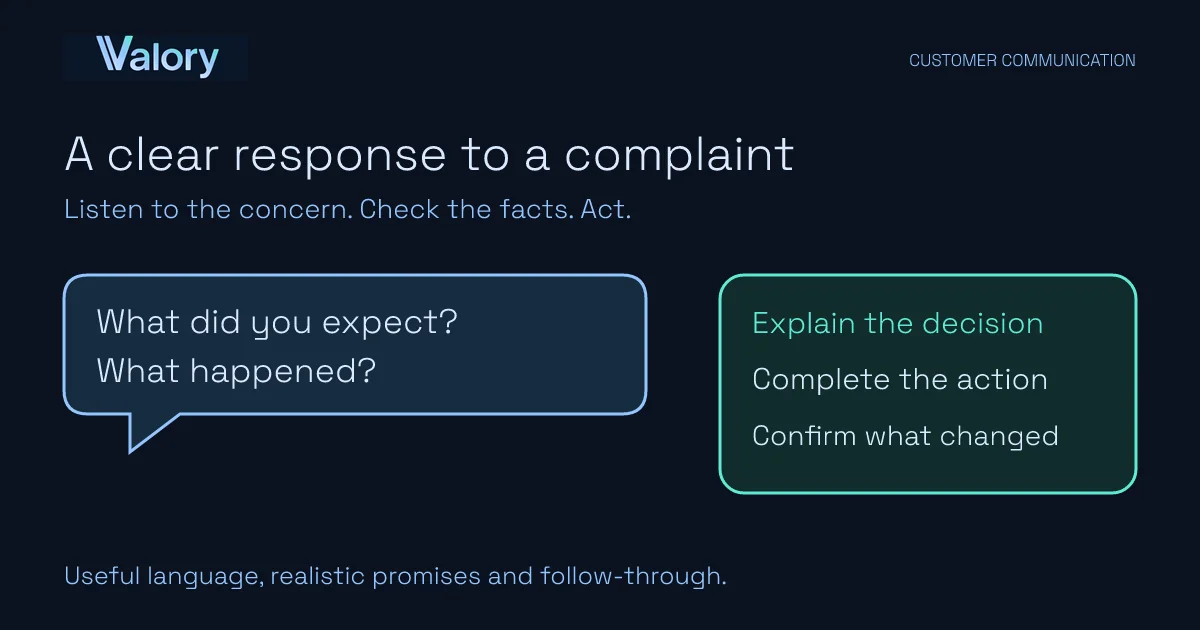
A customer calls because the job was not finished as expected, a promised update never arrived or the invoice does not match their understanding. The person answering may be able to listen and help, but may not have the records or authority to decide the outcome.
A useful complaint process connects that first conversation to a fair decision and a clear response. It should work whether the call reaches the owner, an employee, an answering service or an AI receptionist.
For a small service business, the essentials are practical: understand the concern, avoid unsupported promises, put someone in charge of investigating it and tell the customer what happens next.
Start with the problem the customer is trying to solve
Give the caller room to explain before turning the conversation into a sequence of questions. A complaint may arrive as “I still haven't heard back” or “That isn't what I agreed to”, rather than a formal request to complain.
Listen for what happened, what the customer expected and what they would like the business to do. Repeat the important point in plain language so they can correct it.
For example:
“You expected the second room to be included, and it wasn't cleaned. Have I understood that correctly?”
That acknowledges the concern without deciding whose account is correct. Avoid arguing from an incomplete booking note or telling the caller that the issue is too small to matter.
The Australian Government's complaint-handling guidance recommends listening, keeping records of promises and agreements, gathering relevant supporting information and following up. Your phone process should make those steps easy for the people who handle the issue.
Be clear about what you can decide
The caller needs to know whether the person answering can fix the problem, needs to check something or is arranging contact with someone else.
If a staff member can correct a straightforward administrative mistake within their authority, they should explain the correction and confirm it has been made. If the complaint concerns disputed work, a refund or a promise the records do not support, the next step may require investigation.
An honest response might be:
“I can see why you want that checked. I can't confirm the adjustment from the information I have. I'll ask the service manager to review the booking and contact you.”
Add a time only when the business can meet it. “The manager will call in ten minutes” creates a second problem if the manager is on a job for the rest of the afternoon.
Set authority before the difficult call arrives. Decide which staff can correct a booking, approve rework, discuss a disputed charge or agree a remedy. Give them a backup when the usual decision-maker is absent. Business Queensland's complaint guidance recommends a designated person with authority to organise solutions within agreed limits.
Investigate the specific mismatch
“The customer is unhappy” is too vague to guide a response. The person reviewing the complaint needs to understand the difference between what was expected and what occurred.
Consider three fictional examples:
| Complaint | What needs checking | A useful response can explain |
|---|---|---|
| A cleaning customer says an agreed room was missed | The accepted scope, job instructions and work completed | Whether the room was included and the proposed next step for the missed work or scope disagreement |
| A salon client disputes a cancellation charge | The booking, communicated policy and circumstances raised by the client | What the business has reviewed and the decision it is authorised to make |
| A workshop customer says an update never arrived | The promised update, contact details and adviser notes | The current known status, what remains uncertain and when the next update will come |
These are illustrative business situations, not customer cases or conclusions about who is right. The right action depends on the facts.
Ask only for material that helps resolve the issue. Use the business's agreed channel for receipts, photographs or other documents rather than asking the caller to read sensitive information aloud. Staff should not disclose another customer's details or discuss a private matter merely because someone knows a booking name.
Our privacy and call-recording guide covers the separate considerations for collecting and keeping phone information.
Keep business policy and customer rights in view
A familiar policy is not a shortcut around checking the complaint.
The ACCC explains that the remedy available under consumer guarantees depends on matters such as what was bought and the nature of the problem. A business cannot remove those rights with a blanket “no refunds” policy.
Give the decision to someone who understands the relevant obligations and the customer's circumstances. A phone script should not automatically accept or reject a disputed remedy. This article describes an operating process; it does not determine an individual entitlement or replace any specific complaint requirements applying to your industry.
Keep the customer informed while the issue is open
The business may need time to review a job, speak with a staff member or check a record. During that time, the customer should not have to ring repeatedly to find out whether anyone is working on it.
Agree a realistic update point and distinguish an update from a promised resolution. “We will update you by Thursday afternoon” is different from “This will be fixed by Thursday”. Use the wording that matches what the team can actually commit to.
If an agreed update will be late, contact the customer with what is known and a revised time. Do not claim that an investigation is complete when you are still waiting for evidence.
A fictional progress message could read:
“We have checked the original booking and are still confirming what happened on site. We haven't made a decision yet. I'll update you tomorrow by 3 pm, even if we are still waiting for the final detail.”
That wording is useful only if a named person will make the update. The channel and timing should suit the customer and the business's actual process.
An answering service can receive a complaint; the business still owns it
Reception support can be part of this process, but its role needs to be agreed.
For an AI receptionist, a sensible initial scope is to recognise that the caller is raising a concern, gather the minimum useful context and follow the agreed route to staff. A request to speak with a person should have a clear path. If staff are unavailable, the caller needs an accurate explanation of the next contact, without an invented immediate callback.
Do not make the caller repeatedly defend the complaint to satisfy a qualification script. Nor should a routine FAQ answer be used to close a dispute that requires someone to examine what actually happened.
Refund decisions, disputed liability and sensitive judgement should remain with an authorised person. If a complaint also raises a safety concern, use the business's relevant safety or emergency procedure rather than leaving it in an ordinary callback queue.
For businesses planning reception support, the pilot-to-production guide treats open-ended complaint handling as a poor starting workflow. The practical starting point is a dependable route to the person who can act.
Close the loop on the action, not just the conversation
When the business has a decision, explain what was reviewed, what it will do and when. Use clear wording if the customer requested one outcome and the business is proposing another. Give the customer a way to raise a remaining concern.
Then check that the action happened. A promised return visit is not a completed visit. A refund approval is not evidence that the payment was processed. A message sent to the customer does not, on its own, establish that they received or accepted the answer.
Keep those differences visible. You may have implemented an agreed remedy, sent a decision that remains disputed or been unable to reach the customer. Those situations should not all be described as “resolved”.
For recurring service work, the next ordinary contact is also an opportunity to confirm that the practical problem has stopped. Avoid asking for a positive review as a condition of putting things right.
Use repeated complaints to improve the service
The most useful learning may sit outside reception. Repeated complaints about unexpected charges may point to how prices are explained. Repeated “nobody called me” complaints may point to an unrealistic update promise. Repeated scope disagreements may require clearer job instructions or customer confirmation.
Choose one recurring issue and examine where the expectation and delivery diverged. Make the smallest change likely to address it, then check later complaints for the same pattern. A quieter phone line alone does not establish that customers are satisfied.
For a workshop, our guide to status calls and new enquiries explains how ordinary updates and authorisations differ. For a temporary service interruption, the business phone disruption guide covers communicating known facts while operations recover.
If complaints are getting lost between first contact and your team, book a walkthrough. Bring an anonymised or fictional example of the call and the response you want staff to own. We can discuss an appropriate reception boundary and the next-step process for your business.