Published: 21 March 2026 · Last updated: 6 September 2026
Dental answering service vs AI receptionist
A practical buyer guide for dental practices comparing human answering services, AI receptionists, and hybrid coverage for bookings, after-hours calls, and escalation.
 By Matthew WalkerFounder, Valory AI
If your dental practice is missing calls, the real question is not "Should we buy more software?" It is "What is the safest and most commercial way to make sure new patient calls, booking changes, and after-hours enquiries get handled properly?"
For most practices, the shortlist comes down to three options: keep using voicemail and callbacks, add a human dental answering service, or deploy an AI receptionist with clear rules and escalation. This guide focuses on the middle two so you can compare them in the context that matters most for dentists: new patient conversion, emergency escalation, booking quality, and front-desk workload.
If you want the broader dental workflow view first, start with AI receptionist for dentists in Australia and AI receptionist for dental practices. For after-hours patterns, add After-hours call handling for dental practices.
TL;DR
- A dental answering service is usually the safer fit when you mainly want message-taking, overflow support, and a human voice on every call.
- An AI receptionist is usually the better fit when you want consistent FAQ handling, structured lead capture, appointment booking, and 24/7 coverage without adding headcount.
- Neither option should ever provide clinical advice, quote exact rebate outcomes, or decide whether a dental emergency is "serious enough". Those calls escalate.
- The deciding questions are practical: who can book, who can answer repeat questions consistently, who can handle after-hours volume, and who gives your team better follow-up context the next morning.
- Many dental practices end up with a hybrid model: AI handles routine inbound calls and overflow, while staff or a human service covers sensitive handoffs and edge cases.
The real decision dental practices are making
Dental practices do not lose calls because the team is lazy or inattentive. They lose calls because the front desk is working in the same operating window as everything else that matters:
- patients arriving and checking out
- phones ringing while treatment is underway
- reschedules and cancellations creating calendar churn
- lunch breaks and staff leave reducing live coverage
- after-hours new patient calls landing when nobody is in the practice
The choice between a dental answering service and an AI receptionist is really a choice about service model:
- Do you want a person to answer and take action within a script?
- Or do you want a system that can resolve routine intent directly, then escalate only what needs a human?
What a dental answering service usually does well
A dental answering service is a human-operated call handling layer. In practice, that often means:
- greeting the caller in your practice name
- taking messages and callback details
- following a script for standard questions
- forwarding urgent matters to an on-call number
- covering overflow or after-hours periods
That model works well when your main problem is coverage, not workflow depth.
Strengths of a human answering service
- Human tone from the first second. Some practices value this highly for nervous callers or older patient cohorts.
- Better judgment in odd conversations. A trained operator can recognise when a caller is upset, confused, or difficult to categorise.
- Simple rollout. You can often switch it on quickly with a script and escalation list.
- Useful for overflow. If your front desk usually handles calls well but breaks during peaks, a human answering layer can help.
Limits of a human answering service
- Quality depends heavily on the script, training, and turnover of operators.
- Many services are strongest at message-taking, not deep booking workflows.
- Operators may not know your appointment types, treatment exclusions, parking instructions, or health-fund language as well as your in-house team.
- Handover quality varies. A vague message is still better than voicemail, but it is not the same as structured intake.
What an AI receptionist usually does well
An AI receptionist is best thought of as a workflow layer for routine call types. In a dental context, that usually means:
- identifying the reason for the call from natural language
- answering approved FAQ answers consistently
- capturing name, phone, email, and reason for visit in a structured way
- checking availability and booking when integrated
- handling reschedule and cancellation flows
- escalating clinical or urgent calls immediately
The best fit is when your practice wants more than coverage. It wants resolution.
Strengths of an AI receptionist
- Consistent answers. The AI says the same approved thing every time on hours, location, new-patient intake, and general pricing posture.
- Structured capture. Your team receives follow-up context in a format they can act on quickly.
- After-hours coverage. AI does not "finish at 5pm". That matters when prospective patients call after work.
- Booking potential. With calendar integration, AI can move from "take a message" to "offer times and confirm bookings".
- Low admin drag. The front desk spends less time decoding voicemails and more time on patients in the practice.
Limits of an AI receptionist
- It must be configured carefully. A generic script is not enough for dental.
- It cannot provide clinical advice, comment on symptoms, or quote exact rebate outcomes.
- It needs clear escalation logic for pain, swelling, trauma, bleeding, and post-procedure complications.
- It needs a practice-specific FAQ pack to sound accurate and useful.
Head-to-head for dental practices
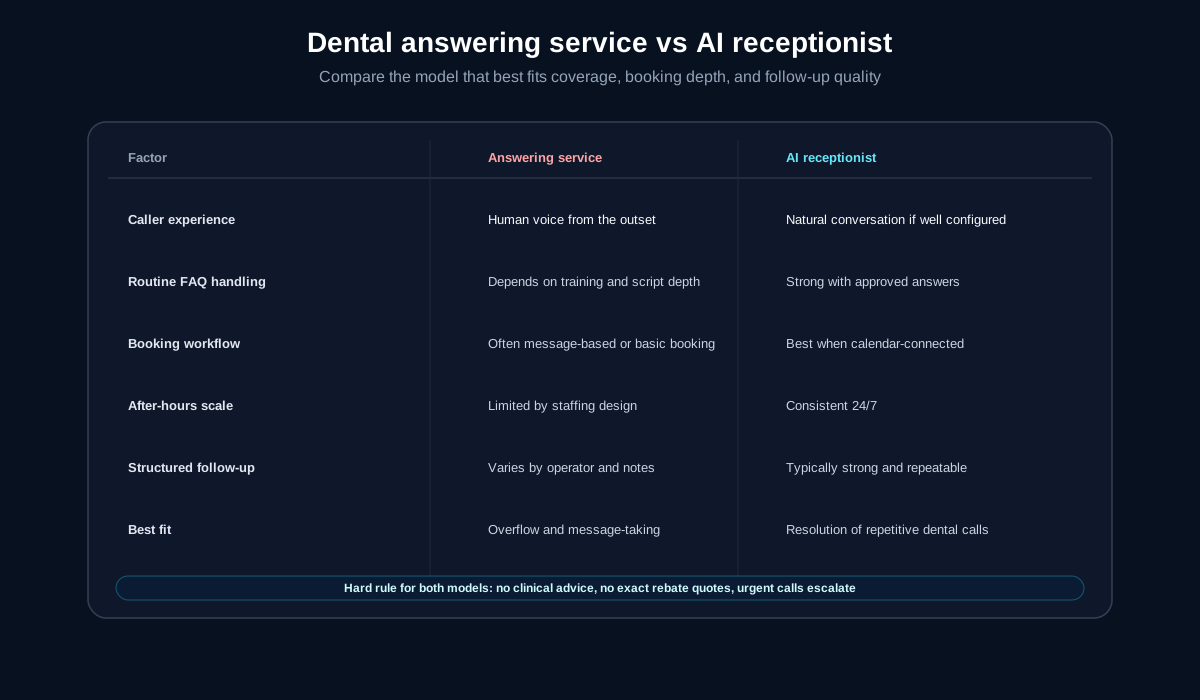
| Factor | Dental answering service | AI receptionist |
|---|---|---|
| First impression | Human from the outset | Conversational but system-led |
| Routine FAQ handling | Depends on operator script quality | Strong when answers are pre-approved |
| Booking depth | Often basic unless operators have full system access | Strong when calendar-integrated |
| After-hours scale | Limited by staffing model and handover process | Consistent 24/7 coverage |
| Structured intake | Varies by service and operator | Usually strong |
| Emergency escalation | Strong when clear on-call rules exist | Strong when keywords and escalation logic are configured well |
| Front-desk time saved | Moderate | High, especially on repetitive call types |
| Best fit | Overflow, sensitivity, message-taking | Resolution, consistency, booking workflows |
When a human answering service is the better fit
Choose a human answering service first if most of the following are true:
- you mainly want overflow or after-hours message-taking
- your booking rules are complex and not yet documented cleanly
- your practice has a high proportion of emotional or high-friction calls
- you are not ready to trust automation with booking or FAQ resolution
- you want a low-change operational layer before tackling deeper process improvement
This is especially reasonable for practices that are still working out their call scripts, escalation list, and front-desk operating standards.
When an AI receptionist is the better fit
Choose an AI receptionist first if most of the following are true:
- your biggest issue is missed new patient calls
- the same booking and FAQ questions repeat every day
- you want better after-hours coverage without hiring more staff
- your team wastes time listening to voicemail and reconstructing what happened
- you can define clear rules for what the AI may answer, book, and escalate
This is where AI tends to outperform a traditional answering service: not because it is "smarter", but because it is more consistent on repetitive workflow.
The hybrid model many practices land on
For dental clinics, a hybrid model is often the most practical:
- AI handles new patient enquiries, booking changes, common FAQs, and after-hours lead capture.
- Staff handle in-practice patient issues, nuanced insurance questions, and clinical matters.
- Urgent or sensitive calls escalate immediately to a human.
That model protects patient experience without forcing the front desk to do everything manually.
Questions to ask before you buy
Whether you are assessing an answering service or an AI receptionist, ask these questions:
- Can it book appointments or only take messages?
- How are urgent dental calls escalated after hours?
- How are health-fund and pricing questions handled?
- What exactly will callers hear when they ask a clinical question?
- What context does my team receive after the call?
- Can I review transcripts, summaries, and outcomes easily?
- How quickly can we update scripts when staff notice a recurring issue?
- How does the system handle cancellations, waitlists, and recall enquiries?
If a vendor cannot answer those clearly, it is not ready for a dental workflow.
Mistakes to avoid
- Treating every call like a message-taking exercise.
- Letting anyone quote exact post-rebate costs without verification.
- Failing to document what counts as urgent.
- Forgetting to include new patient, existing patient, and recall flows separately.
- Choosing technology before deciding what "good call handling" actually means for the practice.
Related guides
- AI receptionist for dentists in Australia - industry landing page and rollout overview.
- AI receptionist for dental practices - full dental call-flow guide.
- After-hours call handling for dental practices - after-hours triage and booking capture.
- How to reduce missed calls in a dental practice - practical operational playbook.
- How much does a receptionist cost in Australia? - full hiring and alternative cost breakdown.
- AI phone agent vs answering service vs voicemail - broader SME comparison.
- AI phone agents in Australia: privacy and call recording - privacy and disclosure basics.
FAQ
Is an answering service safer than AI for a dental clinic?
Not automatically. A human answering service may feel safer because a person is on the line, but safety comes from the workflow design. If either model is allowed to improvise on clinical advice, emergency triage, or rebate quotes, the risk is high. If either model has clear rules and escalation paths, the risk is lower.
Can an AI receptionist book real dental appointments?
Yes, if it is connected to the calendar or practice booking layer. Without integration, it can still capture the request cleanly for staff follow-up. The important question is not "Can it talk?" It is "Can it follow our booking rules without creating more admin?"
What should always stay with a human?
Clinical questions, treatment advice, payment disputes, unusual complaints, and genuinely urgent situations should always escalate to a staff member or dentist. AI is best for routine intent, not judgment-heavy conversations.
What is better for after-hours new patient calls?
In many practices, AI has the edge because it can answer every call immediately, collect structured intake, answer approved questions, and offer a next step. A human answering service can still work well after hours, but outcomes depend more heavily on script quality and handover discipline.
Should I replace my front desk with either option?
Usually no. The better framing is: use a service layer to remove repetitive call load and missed-call leakage, then let your in-practice team focus on patients, billing, treatment coordination, and the conversations that genuinely need a human.
Next step
If your practice is deciding between a human answering service, AI receptionist, or hybrid setup, the fastest next step is to map your top five call types and see which model resolves them best.
You can review pricing, book a walkthrough, contact us, or go back to the core dental overview at AI receptionist for dentists in Australia.